Water Line Repair & Replacement in Milwaukee, WI
Milwaukee Water Line Repair for Homes, Businesses & Multi-Unit Properties
A leaking underground pipe, sudden loss of water, or lead-service-line notice can leave you unsure who to call—and what needs replacing. For Water Line Repair & Replacement Milwaukee WI property owners can discuss with a local team, contact Calat Milwau Plumbing.
We help homeowners, landlords, and commercial property managers understand water-supply problems, evaluate repair options, and plan replacement work. From the pipe entering your basement to service connections supporting busy commercial buildings, the goal is straightforward: identify the problem, explain the scope, and restore dependable water service.
Your next step should not be a guess. Tell us what you are seeing, whether the whole building is affected, and whether Milwaukee Water Works has issued a notice.
- Residential and commercial plumbing support for water-service problems
- Clear explanations of private-side repairs and utility coordination
- Repair and replacement options based on the line’s condition
- Emergency help for active leaks and interrupted water service
Call +1 (414) 279-2050 for 24/7 emergency service inquiries and water-line assessment scheduling across all Milwaukee neighborhoods.
Request Water Line Service
Fill out the form and we'll discuss your water service line immediately!
Water Line Service Built Around Clear Answers
Practical guidance from the first call through the completed project.
Water-line work involves more than replacing a damaged pipe. Owners need to understand responsibility, excavation, access, interruptions, and the condition of the remaining line.
Calat Milwau Plumbing’s supplied business history begins in 1990, with a team of 50 professionals and five equipped service vans. Our service approach centers on explaining what the property needs rather than treating every symptom as an automatic replacement.
Established Since 1990
Established business history serving Milwaukee-area plumbing needs for 35 years.
Residential & Commercial
Residential, commercial, and multi-unit service options with 50 professionals and 5 equipped vans.
24/7 Emergency Availability
Around-the-clock emergency availability for active leaks and sudden water loss. Call (414) 279-2050.
Clear Scope & Communication
Project discussions covering access, shutoff, and restoration with clear communication for owners, tenants, and facility managers.
Water Line Repair Across Milwaukee Neighborhoods & Business Districts
Service for downtown properties, neighborhood homes, and nearby communities.
Water-service work must account for the property—not just its mailing address. A downtown commercial building may require coordinated access and tenant notices, while a neighborhood home may have a service line crossing a landscaped yard before entering the basement.
Calat Milwau Plumbing serves Milwaukee properties around Westown, the Deer District, Historic Third Ward, Walker’s Point, Bay View, Riverwest, and other local communities. Tell us about sidewalks, driveways, building entrances, and meter access when requesting an assessment.
Milwaukee Neighborhoods
Bay View, Riverwest, Harambee, Lincoln Village, Layton Park, Lower East Side, East Town, and Westown.
Nearby Service Areas
Shorewood, Wauwatosa, West Allis, West Milwaukee, St. Francis, Waukesha, Racine, and Kenosha.
Local Property Contexts
Downtown business corridors, neighborhood storefronts, mixed-use buildings, and residential blocks throughout Milwaukee County.
Utility procedures and assistance programs differ between municipalities. A Milwaukee program does not automatically apply to a property in Wauwatosa or another nearby city.
Specialized Diagnosis for Water Service Lines
Understand the location, material, and condition before deciding on the repair.
An underground water leak can involve the street main, the utility-owned connection, the private service line, or plumbing inside the building. The visible wet area does not necessarily identify the failed section.
Milwaukee Water Works calls leaks on the owner’s service-line section “Owner’s Leaks.” Its guidance directs owners to contact a licensed plumber for locating and repairing that problem (Milwaukee Water Works Service-Line Repair Guidance).
When needed, we pair visual inspection with water leak detection and slab leak detection to isolate hidden leaks accurately.
Our assessment discussions address:
- Whether the problem affects one fixture, one building, or neighboring properties
- The likely service-line route and ownership boundary
- Accessible pipe material and previous repair history
- Excavation constraints and meter access
- Repair feasibility versus a more complete replacement plan
What Happens When a Water Service Line Fails?
Leaks and water loss need diagnosis—not assumptions.
A damaged service line can release water underground before the problem becomes obvious. Milwaukee Water Works identifies water soaking a yard, rising from the street, or flowing along pavement edges as possible signs of an underground leak (city.milwaukee.gov).
Other symptoms, including weak flow or sudden water loss, can have several causes. A fixture problem, valve issue, frozen pipe, or utility outage may need a different response than buried-line replacement.
Persistent Wet Ground
Persistent wet ground during otherwise dry conditions along the yard or walkway.
Curb or Entry Water
Water appearing near the curb stop, sidewalk, or building service entrance.
Loss of Water Supply
Whole-building loss of water or a significant change in supply flow and pressure.
Recurring Line Repairs
Recurring repairs on the same service connection indicating broader pipe wear.
Private-Side Leak Notice
A utility notice identifying a private-side leak that requires a licensed plumber.
Business Interruption
Business interruption affecting kitchens, restrooms, or tenant operations — see water damage restoration.
Do not rely on the water bill alone to rule out a service-line leak. A leak before the meter may not appear as metered household consumption.
Does Your Water Line Need Annual Service?
Routine observation helps; annual certification is not a universal water-line requirement.
A buried residential water service line should not be treated like an assembly requiring annual backflow certification. Checks should reflect the property’s condition, previous failures, occupancy, and applicable requirements.
For commercial plumbing systems, a planned review can help managers identify accessible leaks, valve problems, and changes in supply before they disrupt operations.
| Task | Description | Typical timing | Benefit |
|---|---|---|---|
| Accessible pipe inspection | Look for leaks, corrosion, and damaged fittings near the meter | During a plumbing assessment | Identifies visible concerns |
| Supply-performance review | Assess reported changes in flow or pressure | When symptoms appear | Helps narrow the diagnosis |
| Valve assessment | Review accessible shutoff condition and operation where appropriate | During planned service | Supports shutdown planning |
| Record review | Examine notices, previous repairs, and installation records | Before repair or replacement | Clarifies history and scope |
| Replacement recommendation | Evaluate the remaining line’s condition and material | After diagnosis | Supports a longer-term decision |
Seasonal planning
- Address previous freeze concerns before winter.
- Coordinate planned work with tenant schedules and business hours.
- Review unresolved service-line notices before undertaking landscaping or pavement projects.
Frequency: Schedule an assessment when symptoms develop, repairs recur, or a utility notice requires action.
Cost considerations: Assessment and maintenance costs depend on access, diagnostic needs, and any additional work authorized.
Maintenance reminders
- Keep the basement meter area accessible.
- Retain repair invoices and utility correspondence.
- Report recurring wet areas rather than repeatedly covering them.
- Avoid operating unfamiliar or damaged valves.
Who Needs Water Line Repair in Milwaukee?
Support for homeowners, landlords, businesses, and building managers.
The impact of a water-line problem depends on who uses the building. A homeowner may need bathing and cooking restored; a restaurant may need an interruption plan; an apartment owner may need coordinated tenant communication.
Single-Family & Duplexes
Single-family homes and duplexes across Milwaukee neighborhoods.
Apartments & Rentals
Apartment buildings and multi-family rental properties.
Restaurants & Cafés
Restaurants, cafés, and food-service premises.
Retail & Commercial
Retail stores and neighborhood commercial buildings.
Offices & Mixed-Use
Offices and mixed-use developments.
Community & Industrial
Churches, schools, community facilities, warehouses, and industrial properties.
For multi-unit properties, identify the owner or authorized manager before scheduling replacement work. Renters should report the problem promptly and share any utility notice with the property owner.
How Does Milwaukee Weather Affect Water Lines?
Cold-weather diagnosis and site access matter.
Milwaukee Water Works explains that water-main breaks occur more frequently in cold weather. A winter supply problem may therefore involve the utility system, a private service line, or pipes within the building (Milwaukee Water Works Main Replacement & Maintenance).
Cold-Weather Diagnosis
Distinguish frozen indoor plumbing, suspected service-line freezing, and utility outages before planning work.
Thaw & Wet Ground
Investigate recurring wet ground rather than assuming every damp area is snowmelt or sump discharge.
Peak Demand
Review water-demand concerns before concluding that the service line needs replacement.
Pre-Freeze Preparation
Prepare accessible plumbing and review previous freeze-related problems before temperatures drop.
Ground conditions, pavement, landscaping, and access can change the work plan. Emergency availability does not remove the need for safe excavation and utility coordination.
Water Service Line Materials & Connections
The street main, service line, meter, and indoor pipes have different roles.
The water main supplies the street. The service line connects that main to the property’s meter, while interior plumbing distributes water through the building.
Milwaukee’s lead-line overview identifies the main-to-curb-stop portion as city-owned and the curb-stop-to-meter portion as customer-owned (Milwaukee Lead Service Line Overview).
| Material or component | Where it may be encountered | Main consideration | Service approach |
|---|---|---|---|
| Lead service line | Existing service connections | Lead exposure and full-replacement requirements | Coordinate the replacement pathway with Water Works; consider certified water filtration |
| Copper service line | Existing or replacement connections | Joint condition, leaks, and overall integrity | Assess localized repair versus replacement |
| Other existing pipe materials | Property-dependent connections | Material identification and applicable installation rules | Select a compliant, site-appropriate approach |
| Meter-setting connections | Basement or building entry | Accessible fittings, valves, and leaks | Separate connection work from buried-line work |
| Interior distribution piping | Plumbing after the meter | Fixture-specific or building-wide supply problems | Diagnose independently of the service line (pipe repiping) |
Copper pipes inside a home do not establish that the buried service connection is also copper.
Our 6-Step Water Line Repair & Replacement Process
Know what happens before excavation begins.
Initial Call & Property Review
Discuss symptoms, property type, water availability, utility notices, and who can authorize the work.
Site Assessment & Access Planning
Review the meter area, visible piping, likely service route, and excavation constraints.
Diagnostic Evaluation
Assess the evidence and identify what further leak investigation is needed to locate the problem.
Repair or Replacement Proposal
Explain the recommended scope, alternatives, materials, access needs, and exclusions.
Coordination & Authorized Work
Address required utility communication, locating, permits, shutdowns, and installation procedures.
Testing, Restoration & Handover
Check completed connections, communicate return-to-service instructions, and review the agreed cleanup and restoration scope.
For commercial buildings, include tenant notifications and operating constraints in the plan—not as an afterthought.
What Should a Water Line Repair Estimate Include?
A clear proposal separates diagnosis, installation, and restoration.
The right estimate explains the problem being addressed and the limits of the proposed work. “Replace water line” alone leaves too many questions unanswered.
- Property assessment and reported symptoms
- Identified or suspected failure location
- Pipe material and proposed replacement route
- Repair length or replacement extent
- Excavation method and access requirements
- Utility coordination and applicable permit responsibilities
- Meter-area connection and valve work, if included
- Testing and return-to-service procedures
- Backfill, debris removal, and cleanup
- Lawn, sidewalk, driveway, or interior restoration inclusions
- Additional-work authorization process
Ask whether final landscaping and pavement replacement are included, excluded, or handled separately. Contact our team to request a written scope.
Commercial Plumbing in Milwaukee, WI: Water-Service Support
One water-line plan should address both the pipe and the building’s needs.
A useful commercial plumbing proposal accounts for occupancy, access, water demand, and the consequences of a shutdown. Owners should know who needs notifying and which activities must pause.
What Changes After Water Line Repair?
The result should be more than a pipe hidden underground.
Successful work gives the owner a clearer understanding of what failed, what was repaired or replaced, and what remains outside the project scope.
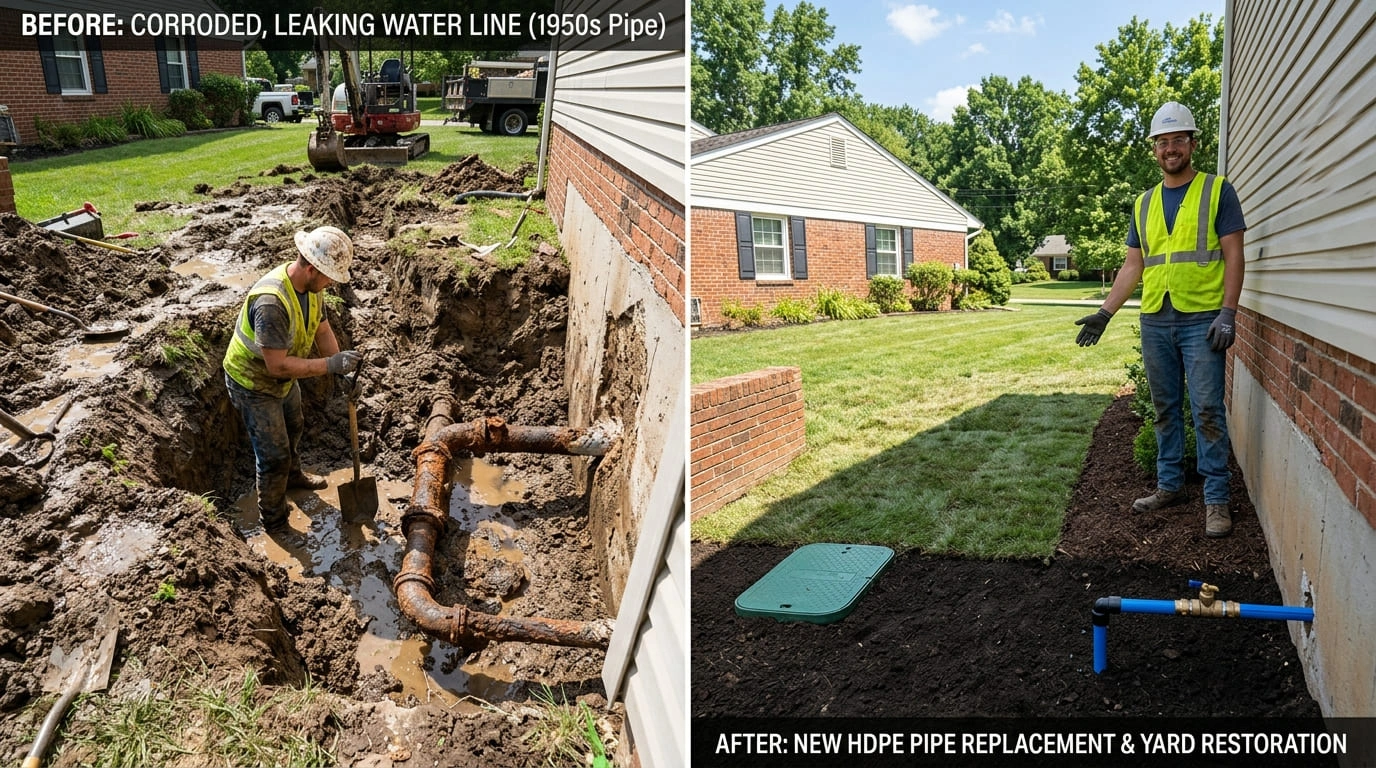
Before: An unexplained wet area along the yard or walk.
After: An investigated problem with a documented water line repair scope.
Before: Uncertainty about the private-side connection.
After: Clear ownership and utility coordination discussions.
Before: An undefined replacement estimate.
After: An agreed route, material, and restoration plan.
Before: Concern about losing water unexpectedly.
After: A communicated shutdown and return-to-service process.
Can a Water Line Be Replaced Without Digging Up the Entire Yard?
Trenchless methods can reduce excavation, but they are not suitable everywhere.
The installation method depends on the existing route, material, connection points, obstructions, and applicable requirements. Some projects permit pulling or boring a replacement line; others need open excavation.
Milwaukee’s replacement materials describe excavation near the curb stop and work involving the basement entry and meter setting. Even a reduced-excavation method may require access pits and interior connection work (Milwaukee Lead Service Line Replacement FAQ).
A trenchless proposal should explain where excavation remains necessary.
Method considerations
- Appropriate material for the approved installation
- Existing and proposed connection locations
- Buried utilities and site obstructions
- Access beneath sidewalks or driveways
- Basement wall or floor entry
- Required fittings, valves, and testing
- Backfill and surface-restoration scope
When Is Full Water Line Replacement the Better Choice?
Consider the whole connection—not only the visible leak.
A localized failure on an otherwise suitable line may allow a targeted repair. Repeated problems, broader deterioration, or lead-service-line requirements can change that decision.
| Situation | Repair may be considered | Replacement may be appropriate |
|---|---|---|
| Isolated damage on a suitable line | If the remaining connection is sound | If broader deterioration is discovered |
| Repeated leaks | May provide a short-term solution | When recurring failures indicate a larger problem |
| Widespread deterioration | Often limited in value | When reliable localized repairs are impractical |
| Lead service-line failure | Do not assume patching is the final solution | Coordinate applicable full-replacement requirements |
| Supply-capacity concerns | Diagnose valves and interior restrictions first | Consider after evaluating actual building demand |
| Coordinated utility project | Assess the available work pathway | Coordinate public- and private-side work where applicable |
Milwaukee’s lead-line ordinance framework requires full replacement with copper in specified situations. The repair decision for a lead connection therefore needs utility coordination, not simply the same patch-versus-replace calculation used for other materials (city.milwaukee.gov).
How Much Does Water Line Replacement Cost in Milwaukee?
Access, length, material, and restoration shape the estimate.
There is no single price that accurately covers every service-line project. A short accessible repair and a replacement beneath pavement have different labor, equipment, and restoration requirements.
Main cost drivers
- Length and depth of the affected line
- Existing material and connection condition
- Excavation or trenchless feasibility
- Sidewalk, driveway, or street-access constraints
- Basement connection work
- Required coordination and permits
- Emergency conditions
- Final restoration scope
| Work type | Estimate considerations |
|---|---|
| Diagnostic assessment | Access, evidence, and leak investigation required |
| Localized repair | Failure location, repair length, and connection method |
| Private-side replacement | Route, material, excavation, and meter connection |
| Commercial service-line project | Demand, access, occupancy, and shutdown coordination |
| Surface restoration | Area disturbed and specified finish |
| Lead-line project | Program route and coordinated public/private scope |
City-program assistance is separate from a private contractor’s estimate. Milwaukee’s voluntary Owner Request Option requires owners to pay the private-side replacement cost and is subject to capacity (city.milwaukee.gov).
Which Water Line Problems Need Professional Attention?
A notice, recurring leak, or interrupted supply deserves a clear next step.
Owner-Side Leak Notice
Milwaukee Water Works identifies an owner-side leak requiring licensed repair.
Repeated Wet Ground
Water repeatedly appears along the suspected underground service route.
Multiple Past Repairs
The same service connection has needed multiple localized repairs.
Lead-Line Notice
A lead-line notice raises questions about pipe material or replacement options.
Unexplained Water Loss
Whole-building water loss or drop in supply remains unexplained.
Planned Construction
Planned remodeling, paving, or construction may affect the existing service line.
Changing Business Demand
A commercial property is changing water demand or occupancy.
Meter-Area Damage
Meter-area corrosion, valve wear, or fitting damage suggests a broader connection problem.
Drinking-Water Protection
Need interim water filtration while planning service-line work.
A lead notice identifies a material concern; it does not by itself establish that a pipe is actively leaking. Review the notice and the address-specific program information before choosing a replacement route.
Water Line Replacement for Commercial & Multi-Unit Properties
Protect operations through clear coordination.
Restaurants, offices, apartment buildings, and mixed-use properties need more than a replacement date. They need a plan for access, water-dependent activities, tenant communication, and return to service.
| Commercial service | Planning focus |
|---|---|
| Leak assessment | Symptoms, affected areas, and operational impact |
| Localized repair | Access and shutdown requirements |
| Service-line replacement | Material, route, demand, and installation scope |
| Connection review | Meter setting, valves, and interior interfaces |
| Project documentation | Work records, invoices, and maintenance information |
| Property situation | Typical consideration |
|---|---|
| Multiple tenants | Advance communication and access coordination |
| Extended business hours | Shutdown timing and operational constraints |
| Industrial operations | Site-specific safety and demand requirements |
| Larger buildings | Connection sizing and broader plumbing interfaces |
Property types we serve
Commercial planning advantages
- A clearly defined authorized decision-maker
- Notices tailored to affected occupants
- Written restoration responsibilities
- Scheduling discussions around critical operations
Why Hire a Professional for Water Line Repair?
The value is in correct decisions, not simply new pipe.
Professional assessment helps owners distinguish a service-line problem from a fixture restriction, interior leak, or utility interruption.
Defined Options
Better-defined repair and replacement options based on actual line conditions.
Utility Coordination
Appropriate utility and installation coordination with Milwaukee Water Works.
Clear Access Plan
A written understanding of excavation, basement entry, and site access.
Verified Connections
Thorough testing of completed connections before returning the line to service.
Restoration Clarity
Clearer restoration expectations for yard, sidewalk, driveway, and interior areas.
Project Records
Complete records for future ownership, maintenance, or insurance inquiries.
A careful diagnosis can also prevent unnecessary replacement when the problem lies elsewhere.
Why Is DIY Underground Water Line Work Risky?
Buried utilities and unfamiliar shutoffs require caution.
Do not begin digging based only on where you think the water line runs. Wisconsin requires advance notification through Diggers Hotline before excavation; standard planning calls for at least three working days to allow utility marking (Wisconsin PSC Diggers Hotline · Diggers Hotline Homeowner FAQ).
Safety reminders
- Do not operate the utility’s curb stop without authorization.
- Avoid entering unstable excavations.
- Keep away from water near electrical equipment.
- Do not use an open flame to thaw plumbing.
- Report suspected street-side leaks to Milwaukee Water Works.
- Follow official drinking-water instructions after lead-line work.
Boiling water does not remove lead. Use the city’s lead-risk guidance and an appropriate lead-reduction water filter rather than treating boiling as a solution (Milwaukee Lead-Safe Water Guide · Water Works Lead Pipe Information).
Answers About Leaks, Lead Lines, Costs & Disruption
Start with responsibility, then choose the right service pathway.
Who repairs the water line between the curb and my house?
In Milwaukee, the owner’s portion runs from the curb stop to the meter. Water Works directs owners to contact a licensed plumber for owner-side leak repairs (city.milwaukee.gov). Contact Calat Milwau Plumbing to schedule an assessment.
Should I call Water Works or a plumber?
Report suspected underground leaks to Water Works. For utility water emergencies, its 24-hour Control Center is 414-286-3710. Private-side repair work requires an appropriate plumbing contractor (city.milwaukee.gov).
Does “before the meter” mean the city pays?
No. The curb-stop-to-meter section is customer-owned even though it is before the meter (Milwaukee Lead Pipes Overview).
Why did I receive a lead service-line letter?
The notice concerns the recorded material classification. Read the specific classification and address information; do not treat it as proof of an active leak.
What does “unknown material” mean?
It means the available record has not established the material classification. Ask Water Works how the address record can be clarified.
Why does the map disagree with my letter?
Contact Water Works with the address and notice. Conflicting records should be reconciled through the utility rather than neighborhood assumptions.
Is replacement free?
Not every replacement pathway has the same funding. Address eligibility and project inclusion matter; the voluntary owner-request route requires private-side payment (city.milwaukee.gov).
Will the cost go on my tax bill?
Not automatically. Water Works describes a separate, criteria-based tax-roll process for certain owner-leak situations. Ask about applicable terms before relying on this option (city.milwaukee.gov).
Does replacing the street main replace my service line?
Do not assume it does. Ask for the project’s public- and private-side scope.
How do I check my replacement schedule?
Use Water Works’ address-based mapping information. Neighborhood selection does not establish that every property is included (city.milwaukee.gov).
Will workers need basement access?
Often, connection work involves the meter setting or service entry. Discuss clearances and any wall or floor work before scheduling (Lead Service Line FAQ PDF).
How long will the water be off?
The work method and property conditions determine the interruption. Request a project-specific expectation rather than relying on another household’s experience.
Who restores the yard or pavement?
The proposal should identify who handles backfill, lawn repair, pavement, and final finishes.
Does service-line replacement include indoor repiping?
Not automatically. Interior distribution is a separate scope unless expressly included. See our pipe repiping service if indoor pipes also need attention.
What should renters do?
Notify the owner or property manager, share the notice, and report active leaks or water loss promptly. Replacement authorization generally needs owner involvement.
What happens after lead-line replacement?
Follow the project’s flushing, filtering, and testing instructions. Milwaukee Water Works provides dedicated lead-risk and water-testing resources (city.milwaukee.gov). We also service water filtration systems.
Know What Your Water Line Project Covers
Understand the scope, support, and written terms before approving work.
Calat Milwau Plumbing’s service discussion should leave you knowing what is proposed, what remains outside the scope, and how concerns after completion will be handled.
The estimate and written service terms define the applicable workmanship commitments, material coverage, and corrective-service process. Keep these records with the completed-work documentation.
Calat Milwau Plumbing836–838 N Old World 3rd St
Milwaukee, WI 53203
United States • Westown, Milwaukee
Plumbing Credentials for Water-Service Projects
Understand who is responsible for the installation.
Water-service repairs involve installation rules, public safety, and coordination beyond ordinary handyman work. Milwaukee Water Works specifically directs owners to licensed plumbers for owner-side leaks (city.milwaukee.gov).
Relevant credential categories listed in the business profile include:
- Master Plumber — Meet our team
- Journeyman Plumber
- Journeyman Plumber–Restricted Service
- Master Plumber–Restricted Appliance
- Registered Plumbing Apprentice
Scope & Supervision
Restricted credentials have defined scopes; an apprentice designation is not equivalent to independent master-plumber authority. Ask who will supervise and perform the specific water-line work.
What Should You Do When Your Building Suddenly Has No Water?
Identify the affected area and contact the appropriate service.
A sudden outage may involve a street main, closed valve, frozen pipe, or damaged service line. Tell us whether neighboring properties are affected and whether every fixture has lost water.
Emergency process
- Discuss symptoms and immediate site conditions.
- Identify utility notices or known area outages.
- Review safe access and who can authorize work.
- Assess the repair or leak investigation needed.
- Explain any coordination that must precede excavation.
Emergency scenarios
- Water emerging along the service route
- Significant water loss at a building entry — see water damage restoration
- An owner-leak notice requiring action
- Whole-building supply interruption
- Suspected freeze-related damage
For utility water emergencies, call Milwaukee Water Works at 414-286-3710. For private-property plumbing assistance, call Calat Milwau Plumbing at +1 (414) 279-2050 (city.milwaukee.gov).
Documentation to Support Your Insurance Inquiry
Separate the repair scope from the insurer’s coverage decision.
If a water-line failure causes damage, useful records can help explain what was observed and what work was performed. Coverage depends on the actual policy, endorsements, exclusions, and cause of loss.
Photos of Damage
Photos of accessible damage taken safely before repair.
Inspection Observations
Written observations from the on-site plumbing assessment.
Location & Material
Location and pipe material information for the affected section.
Repair or Replacement Scope
Clear description of the repair or replacement work performed.
Itemized Invoices
Itemized invoices detailing labor, materials, and charges.
Restoration Records
Records of additional restoration work if applicable.
Ask your insurer whether service-line coverage applies. Do not assume ordinary homeowners insurance covers every buried-pipe failure or that repair approval establishes coverage.
What Should a Water Line Warranty Explain?
Workmanship and material protection are different.
Keep warranty terms with the estimate, invoice, and installation records. A useful warranty explains the covered work, duration, exclusions, and process for reporting a concern.
| Coverage category | What to understand |
|---|---|
| Workmanship | Covered installation or repair work and applicable term |
| Materials | Product-specific manufacturer terms |
| Exclusions | Conditions or unrelated components outside coverage |
| Service procedure | How to report a concern and arrange assessment |
| Documentation | Records needed to identify the completed project |
A warranty on a repaired section does not automatically cover every existing pipe on the property.
Five Equipped Service Vans Supporting Local Plumbing Work
Match the resources to the job.
Calat Milwau Plumbing’s supplied fleet consists of five equipped service vans. Water-line projects may also require resources beyond a standard service vehicle, depending on excavation, access, and the installation method.
Equipment planning includes:
- Diagnostic tools suited to the suspected problem
- Appropriate fittings and installation materials
- Excavation or reduced-excavation resources where needed
- Testing equipment appropriate to the completed work
- Site protection and cleanup requirements
Project Planning Note
A stocked van does not mean every underground replacement can be completed in one visit. The assessment determines the project requirements.
Payment Planning for Major Water Line Projects
Understand contractor costs and municipal assistance separately.
A significant replacement can affect the household or building budget. Request an itemized estimate and discuss payment arrangements before work begins.
Budget considerations
- Separate diagnostic costs from installation costs.
- Identify restoration allowances and exclusions.
- Ask about payment timing and any available arrangements.
- Compare lending terms with applicable municipal options.
- Establish how unexpected conditions will be authorized.
Municipal Assistance & Tax-Roll Info
Milwaukee’s owner-leak guidance describes possible assistance resources and a separate tax-roll process with eligibility requirements and additional charges. Enrollment is not automatic (city.milwaukee.gov).
What Matters When Evaluating a Milwaukee Plumbing Company?
Recognition should support—not replace—a clear project proposal.
When choosing a water-line contractor, focus on the proposed diagnosis, applicable qualifications, scope, communication, and written terms. An award label alone does not explain whether the contractor’s approach is right for the property.
Choose based on what the contractor will actually deliver for your project.
Water Line Service Hours in Milwaukee, WI
Call any day to discuss an urgent plumbing problem.
Calat Milwau Plumbing lists 24/7 emergency availability. Planned assessments and replacement work require scheduling around site access, utility coordination, and project conditions.
| Day | Emergency availability |
|---|---|
| Monday | 24 hours |
| Tuesday | 24 hours |
| Wednesday | 24 hours |
| Thursday | 24 hours |
| Friday | 24 hours |
| Saturday | 24 hours |
| Sunday | 24 hours |
Phone: +1 (414) 279-2050
Email: calatmilwauplumbing@gmail.com
Website: Calat Milwau Plumbing
Address: 836–838 N Old World 3rd St, Milwaukee, WI 53203
For active water-line leaks or sudden loss of water, call rather than waiting on email. Use our online contact page for planned assessments.
How Should You Compare Water Line Repair Providers?
Use the same questions for every estimate.
A lower total may exclude diagnosis, pavement repair, basement work, or final restoration. Compare proposals on matching terms rather than assuming every quote covers the same project.
| Feature | Discuss with Calat Milwau Plumbing | Ask every provider |
|---|---|---|
| Diagnosis | What evidence supports the proposed work? | Is the failure location established? |
| Ownership | Which section is being repaired? | Who coordinates utility involvement? |
| Method | Why is this installation approach proposed? | Where will excavation still occur? |
| Scope | What connections and valves are included? | What work is excluded? |
| Restoration | What finish is specified? | Who handles lawn, concrete, or interior repair? |
| Schedule | What access and shutdown are needed? | What could change the timeline? |
| Warranty | What written terms apply? | What is covered and for how long? |
| Price changes | How are unexpected conditions handled? | Is additional approval required? |
The best comparison is a clear, like-for-like scope—not unsupported claims about other companies. Learn more about our team and plumbing services.
Contact Calat Milwau Plumbing for Water Line Repair in Milwaukee
Get a practical next step for leaks, supply loss, and replacement planning.
Whether you have an active leak, an owner’s-leak notice, a lead-line question, or a commercial property needing coordinated work, start with the details. Tell us your address, the symptoms, the affected fixtures or units, and any communication from Milwaukee Water Works.
For properties across the Milwaukee County service area, include basement access, operating hours, and who can authorize the work so the assessment can be planned efficiently.
Contact Details
Protect your property and plan dependable water service with Water Line Repair & Replacement Milwaukee WI homeowners and businesses can discuss with Calat Milwau Plumbing.
Plumber Milwaukee WI — Service Area Coverage
When you need an emergency plumber in Milwaukee, our team of 50 professionals responds fast. We serve the entire Milwaukee region, including all surrounding suburbs and neighborhoods with 5 fully equipped service vans.
Cities & Neighborhoods Around Milwaukee WI
Get Emergency Plumbing in Milwaukee WI Now
Need an emergency plumber in Milwaukee WI? Our 50 skilled professionals are standing by 24/7. Reach out about our plumbing services and we'll dispatch a Master Plumber immediately. Also serving water line repair and sewer line repair needs.
Contact Calat Milwau Plumbing
Current Special Offers
- Basic Drain Clearing Flat-Rate Special
- Battery Backup Sump Pump Rebate
- First-Time Customer Discount
- Tiered Repair Service Credit
- Whole-Home Repipe Project Discount