Sewer Line Camera Inspection in Milwaukee, WI — Clear Answers for Recurring Backups
Milwaukee County sewer inspection services for homes, businesses, and multi-unit properties
When you need sewer camera inspection in Milwaukee, WI, you need more than another temporary fix. You need to understand why the basement drain keeps backing up, where roots are entering the lateral, or whether the sewer line beneath a property deserves attention before you buy.
Calat Milwau Plumbing helps homeowners, business owners, and property managers move from uncertainty to an informed next step. Established in 1990, our operation includes 50 skilled professionals and five equipped service vans, with 24/7 emergency plumbing availability. From scheduled sewer scopes to urgent backup assessments, we connect diagnostic findings with practical options for cleaning, maintenance, and repair.
- Investigate recurring sewer backups and slow main drains.
- Evaluate visible roots, damaged joints, and pipe obstructions.
- Discuss sewer scopes before buying a house.
- Arrange residential and commercial plumbing support.
- Get emergency help when wastewater threatens your property.
Call +1 (414) 279-2050 to discuss your symptoms, inspection access, appointment availability, and documentation needs.
Request a Sewer Inspection
Tell us what is backing up and what you need to learn.
Urgent backup? Call (414) 279-2050.
Sewer Diagnostics Backed by Decades of Plumbing Experience
Useful findings explain what the camera shows, what remains uncertain, and what may need attention
A useful inspection should explain what the camera shows, what remains uncertain, and whether the findings call for immediate action or continued monitoring.
Calat Milwau Plumbing brings sewer diagnostics together with drain cleaning, hydro jetting, and sewer line repair. That broader perspective helps evaluate the problem without treating every root, crack, or small amount of standing water as a reason to replace the entire pipe.
MMSD distinguishes minor findings, conditions worth monitoring, and defects needing urgent attention. Your recommendations should make those differences clear. MMSD lateral guidance.
Established in 1990
Serving Milwaukee-area plumbing needs for decades.
50 Skilled Professionals
A broad plumbing team for residential and commercial work.
Five Equipped Vans
Service capacity across local properties.
Residential & Commercial
Diagnostics for homes, businesses, and multi-unit properties.
Defined Inspection Scope
Discuss coverage, access, recording, and limitations.
24/7 Emergency Plumbing
Call when a backup threatens your property.
Sewer Camera Inspections Near Milwaukee Neighborhoods and Business Hubs
Local context helps with access and scheduling—not with diagnosing a buried pipe
From homes in Bay View and Riverwest to mixed-use properties around the Historic Third Ward, drainage problems can interrupt daily life quickly. Restaurants, offices, and apartment buildings near downtown destinations such as Fiserv Forum and the Milwaukee Public Market also need access-conscious scheduling that limits disruption.
Our Greater Milwaukee sewer inspection appointments begin with the property itself: its symptoms, available cleanouts, building layout, and inspection objectives. A recognizable landmark helps with location—not with diagnosing the buried pipe.
Milwaukee Neighborhoods
- Bay View
- Brewers Hill
- East Town
- Harambee
- Historic Third Ward
- Lower East Side
- Riverwest
- Walker’s Point
- Westown
Nearby Communities & Business Areas
- Shorewood and St. Francis
- Wauwatosa, West Allis, and West Milwaukee
- Waukesha, Racine, and Kenosha
- Downtown Milwaukee and the Harbor District
- Menomonee River Valley and neighborhood business corridors
Call with your address so we can discuss scheduling and the appropriate service arrangements. View service areas.
Specialized Camera Inspections for Sewer Laterals and Commercial Drains
A clear image is only the beginning of a useful diagnosis
Your technician needs to consider access direction, pipe condition, flow, obstruction severity, and whether the inspected section represents the complete problem. A commercial drain camera inspection also requires attention to building operations, tenant access, and the distinction between a branch drain and the main building sewer.
Our Inspection Approach
- Select an appropriate access point.
- Record the inspected section and identify its limits.
- Relate visible findings to the symptoms reported.
- Separate cleaning needs from structural repair concerns.
- Explain when additional investigation is necessary.
An inspection should support a decision—not pressure you into one. Related options may include drain cleaning or sewer-line repair.
Why Does Your Basement Drain Keep Backing Up After Snaking?
A temporary opening may not correct the condition that caused a blockage
Snaking can reopen a blocked pipe without resolving the condition that allowed the blockage to develop. Roots, displaced joints, damaged sections, and recurring deposits may continue to interfere with drainage.
MMSD explains that roots can enter damaged laterals and catch material moving through the pipe. It also notes that backups during dry weather can indicate wastewater from the home cannot pass through the lateral to the public sewer. MMSD sewer lateral guidance.
Basement Floor Drain Backup
Especially during laundry or shower use.
Several Fixtures Slow
Multiple affected fixtures may point to a main-drain concern.
Returns After Clearing
Symptoms reappear after recent main-line service.
Recurring Root Removal
Roots or repeated main sewer cleaning deserve context.
Wet-Weather Debris
Debris around a floor drain after rain may be a warning.
Business Disruption
Drainage failure affects normal operations.
A wet basement does not automatically mean a damaged sewer lateral. Foundation seepage, sump discharge, and public-sewer conditions may require a different investigation. Learn about sump-pump service and water-damage restoration.
How Often Should Your Sewer Lateral Be Inspected?
Follow pipe condition and history—not an invented annual certification requirement
For laterals needing regular root removal, MMSD suggests video inspection every five to ten years. It also states that a lateral in good condition may not need reinspection for the foreseeable future. New symptoms, repairs, or an incomplete earlier scope can justify earlier investigation. MMSD lateral inspection guidance.
| Task | Description | Typical Timing | Practical Value |
|---|---|---|---|
| Symptom review | Review backups, slow drainage, and previous cleaning | Before scheduling | Defines the inspection objective |
| Camera examination | View accessible sewer sections and record visible conditions | Based on symptoms and history | Documents inspected areas |
| Cleaning assessment | Determine whether deposits or roots prevent useful viewing | When visibility or access is restricted | Identifies preparation work |
| Findings documentation | Describe defects, distances, and inspection limitations | Following inspection | Supports maintenance and repair decisions |
| Follow-up recommendation | Recommend monitoring, cleaning, or further investigation | Based on findings | Creates a condition-based plan |
Useful Scheduling Considerations
- Investigate recurring wet-weather backups before another heavy-rain event.
- Arrange access before a busy commercial operating period.
- Coordinate sewer checks with planned renovation or lateral repairs.
Prepare for the Visit
Inspection costs depend on access, coverage, preparation work, and documentation requirements. Keep cleanouts accessible, retain previous videos and reports, and address changing drainage symptoms rather than waiting for another overflow.
Who Benefits From Residential and Commercial Sewer Diagnostics?
Investigate a specific property question—not a generic checklist
The right inspection answers a specific property question: Why does the drain keep clogging? What is beneath the yard? Can this building support reliable daily operation?
Homeowners
Investigate repeated basement backups.
Homebuyers & Sellers
Evaluate a property’s sewer lateral history.
Restaurants & Kitchens
Assess recurring drainage problems.
Offices & Mixed Use
Investigate building drainage issues.
Apartments & HOAs
Coordinate access across multi-family properties.
Warehouses & Facilities
Review accessible drainage systems.
The scope depends on the building and the line involved. A household lateral scope is not the same assignment as investigating multiple commercial branches. For additional building support, see commercial plumbing.
How Do Rain, Groundwater, and Building Use Affect Sewer Performance?
Rain does not prove that the public sewer is the cause
A blocked private lateral can back up during wet weather, while cracks and leaking joints can admit groundwater into the sanitary system. MMSD notes that simultaneous backups at neighboring properties can indicate a full public sanitary sewer and recommends contacting the local public works department. MMSD lateral guidance.
For commercial plumbing systems, occupancy, kitchen discharge, and operating schedules may be as important as the season. See commercial plumbing support.
What Types of Sewer Pipes Can a Camera Inspection Evaluate?
Interpretation depends on material, condition, connections, and inspection purpose
A camera scope can document the visible interior of accessible pipes. MMSD identifies older clay laterals and newer PVC laterals as common local examples, while noting that clay joints and damaged sections can be vulnerable to root intrusion. MMSD lateral information.
| Pipe or System Type | Typical Inspection Focus | Potential Concerns | Inspection Value |
|---|---|---|---|
| Clay sewer lateral | Joints, alignment, roots, and visible damage | Root entry, cracks, displaced joints | Shows where recurring problems may originate |
| Cast-iron drainage | Interior condition and visible restrictions | Deposits, deterioration, reduced opening | Helps assess cleaning and further investigation |
| PVC sewer piping | Connections, alignment, and visible defects | Installation-related or later-developed problems | Documents condition without assuming plastic is problem-free |
| Previously lined lateral | Liner surface, connections, and accessible transitions | Visible irregularities or remaining restrictions | Supports post-work review and future planning |
A clear-looking section does not establish the condition of an uninspected section. Access limitations must remain part of the findings.
Our Six-Step Sewer Camera Inspection Process
From the first call to the follow-up plan
Initial Call & Property Assessment
Share backup history, affected fixtures, previous work, and whether the scope is for purchase, maintenance, or repair planning.
Inspection Access & Setup
Identify suitable access, review the work area, and discuss scope conditions.
Camera Examination & Recording
Examine the accessible line for visible defects, obstructions, and distance references.
Findings & Next-Step Options
Discuss cleaning, monitoring, additional investigation, or repair planning.
Documentation & Scope Review
Identify the inspected section, relevant locations, and points where the inspection stopped.
Follow-Up Planning
Review authorized added work and whether maintenance or reinspection is appropriate.
MMSD recommends recording the full lateral from the house access point to the main connection, using a running footage counter, and documenting defect or blockage locations. See MMSD recommendations.
What Should Your Sewer Camera Inspection Include?
Know what you are purchasing before the camera enters the pipe
Inspection, cleaning, locating, and repairs are different tasks, even when they happen during the same appointment.
Discuss These Deliverables When Booking
- Pre-visit review of symptoms and inspection objectives.
- Assessment of suitable access points.
- Camera examination of the agreed accessible line.
- Recording arrangements and distance references.
- Explanation of visible findings.
- Identification of incomplete or obscured sections.
- Report and video-copy arrangements.
- Separate recommendations for additional work.
Do Not Assume These Are Included
- Drain clearing or hydro jetting
- Toilet removal or cleanout installation
- Excavation or electronic locating
- Pipe repair or replacement
- Restoration following construction work
Any necessary additions should be explained and authorized separately. Related services include drain cleaning, hydro jetting, and sewer-line repair.
Practical Advantages of a Documented Sewer Inspection
Clear evidence and understandable communication belong together
Useful sewer diagnostics combine technical observation with understandable communication. Calat Milwau Plumbing’s service approach connects the inspection with the questions owners actually need answered: Is the line blocked? Is there visible damage? What should happen next?
Symptom-Led Assessment
Start with the reported issue rather than a generic camera run.
Coverage & Access Limits
Discuss where the camera could and could not travel.
Residential & Commercial
Diagnostics for homes and businesses — commercial plumbing.
Separate Diagnosis & Repairs
Understand the inspection findings before deciding on corrective work.
Useful Documentation
Records can support a second opinion and future planning.
Emergency Plumbing Availability
Call when a drainage failure becomes urgent.
The goal is a defensible next step—not a replacement recommendation by default.
What Changes After a Sewer Line Inspection?
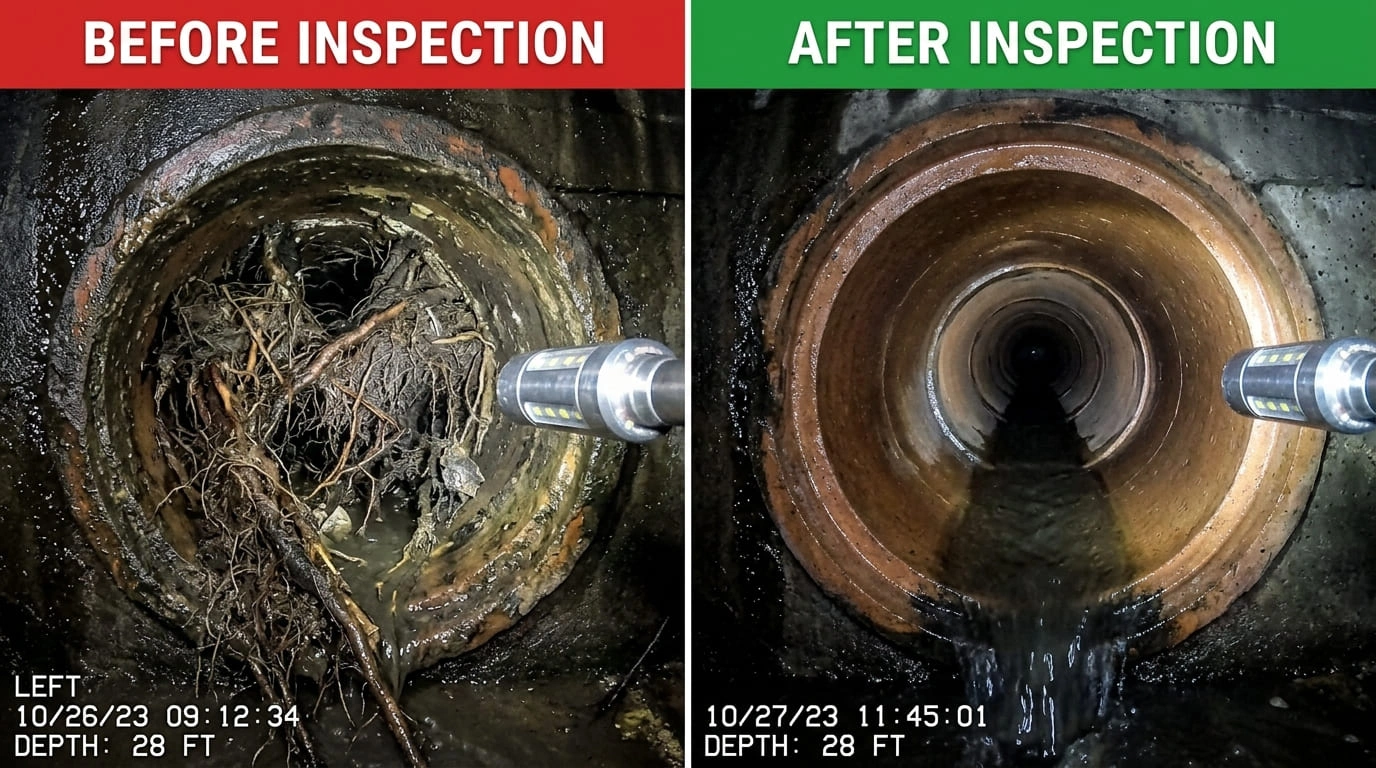
Know What Was Visible—and What Was Not
Before an inspection, you may know only that the basement drain backed up again. Afterward, you should have a clearer account of the accessible pipe’s condition and the remaining questions.
Inspection itself does not remove roots, repair cracks, or guarantee future drainage. Its value is identifying and documenting conditions so appropriate work can be considered.
- Before: Repeated backups with no recorded pipe condition. After: Documented visible findings and a maintenance or repair discussion.
- Before: An assumed root problem. After: Evidence showing where roots are visible and whether they restrict the line.
- Before: Uncertainty after cleaning. After: Follow-up footage showing the accessible condition once deposits are removed.
- Before: A major repair proposal without understandable evidence. After: A video and findings summary that can support further review.
How Do Sewer Cameras, Recordings, and Locating Support Diagnosis?
The method should fit the pipe and its condition
A camera needs usable access and sufficient visibility; it should not be forced through a section that could damage equipment or worsen the situation.
A camera-distance reading is not a complete excavation plan. MMSD advises professional utility locating through Diggers Hotline before digging. MMSD lateral guidance.
Do Roots or Cracks Mean You Need a New Sewer Line?
Not necessarily—the significance depends on severity and effect on flow
The next step depends on the severity of a finding, its effect on flow, its extent, and its relationship to recurring symptoms. MMSD distinguishes minor findings from heavy roots, collapsed pipe, and offsets that interrupt flow. It also describes spot repairs, lining, pipe bursting, and open-cut replacement as different rehabilitation options. Review MMSD lateral guidance.
| Finding | Cleaning or Monitoring May Fit | Repair or Replacement May Fit |
|---|---|---|
| Minor roots or deposits | When manageable and not substantially restricting flow | When symptoms recur or damage worsens |
| Small sag with limited standing water | When drainage remains functional and monitoring is appropriate | When flow disruption or repeated buildup warrants correction |
| Isolated damaged section | Cleaning alone will not restore missing structure | A spot repair may address a localized defect |
| Heavy roots or flow-blocking offset | Clearing may restore temporary access | Further structural assessment and repair planning may be needed |
| Broken, missing, or collapsed pipe | Routine cleaning is not a structural solution | Prompt repair assessment is appropriate |
Replacement becomes more relevant when the pipe is extensively damaged, repair options are unsuitable, or repeated failures cannot be managed reasonably. A camera scope informs the decision; it does not automatically establish trenchless eligibility.
How Much Does a Sewer Camera Inspection Cost in Milwaukee?
Price depends on access, coverage, preparation, and deliverables
Your price depends on how the line can be accessed, how much pipe must be examined, and whether preparation work is needed.
For general budgeting, HomeGuide reports a national sewer-camera inspection range of approximately 125–500. That is not a Calat Milwau Plumbing quote or a Milwaukee-specific average. HomeGuide cost reference.
Important Cost Drivers
- Existing cleanout availability
- Line length and number of sections
- Blockage severity and preparation work
- Video, report, and locating requirements
- Residential versus complex commercial scope
- Scheduled versus emergency service arrangements
Get a Defined Estimate
Clarify the intended coverage, access, recording, and any cleaning or locating work before authorizing the appointment.
Request a Sewer Inspection EstimateCall (414) 279-2050 to discuss your property.
| Service Type | Budgeting Guidance | What to Clarify |
|---|---|---|
| Accessible residential camera scope | National reference: approximately 125–500 | Included line coverage and documentation |
| Inspection with drain cleaning | Property-specific estimate | Separate cleaning charges and reinspection |
| Inspection with locating | Property-specific estimate | Number of locations and marking requirements |
| Commercial or multi-line investigation | Scope-based proposal | Branches, access, scheduling, and reporting |
| Inspection requiring new access | Separate assessment | Access work, restoration, and authorization |
Ask for the scope in writing before work begins. Financial assistance for qualifying repair projects is separate from the cost of a routine camera appointment.
Which Milwaukee Properties Should Consider a Sewer Inspection?
A camera scope is useful when you need evidence about a buried line
Consider an inspection when you need to understand the history or visible condition of a sewer lateral—not simply because a property appears on a generic required-service list.
Repeated Basement Backups
The same drain or several fixtures are affected.
Temporary Relief After Cleaning
Main-line clearing does not resolve recurring symptoms.
Recurring Root Removal
Document the condition associated with repeated root cutting.
Property Purchase
Investigate a lateral with unknown history.
Unclear Repair Records
Earlier work lacks understandable documentation.
Commercial Disruption
Drainage failure is affecting business operations.
For homebuyers, arrange the scope within the purchase timeline and coordinate with the inspection agreement. Do not assume a standard home inspection already includes a recorded lateral examination. For wet basements involving Palmer valves or foundation drainage, identify the system before choosing the scope.
Commercial Sewer Camera Inspection in Milwaukee
Define the investigation plan, access, and records around your operations
Restaurants, apartment buildings, offices, and industrial properties need more than an appointment window. They need a defined investigation plan, access coordination, and clear information for the person authorizing work.
Calat Milwau Plumbing helps commercial clients connect recurring drain problems with practical diagnostic steps. We discuss tenant access, operating hours, affected areas, and the difference between branch-line problems and the main building sewer.
| Commercial Service | Description |
|---|---|
| Main sewer investigation | Examine agreed accessible building-sewer sections |
| Recurring drain assessment | Relate camera observations to repeated blockage history |
| Cleaning coordination | Discuss authorized preparation or follow-up cleaning |
| Repair planning | Document visible concerns for a separate repair proposal |
| Inspection records | Clarify video, report, and location-reference requirements |
Commercial Properties
- Restaurants and hospitality venues
- Shopping centers and mixed-use buildings
- Apartment communities and managed portfolios
- Schools, churches, and community facilities
- Warehouses and industrial premises
Why Coordinate Commercial Work?
- One discussion covering diagnostics and related plumbing needs
- Scheduling around occupancy and operations
- Clear boundaries between investigation and corrective work
- Documentation suited to the agreed assignment
| Project Type | Planning Considerations |
|---|---|
| Multi-unit building | Tenant notices, shared access, and affected fixtures |
| Large campus | Phased coverage and building-specific records |
| Restaurant | Operating schedule and grease-related cleaning needs |
| Industrial site | Site safety, access restrictions, and drainage-system identification |
Why Do Professional Sewer Diagnostics Matter?
A documented inspection can reduce uncertainty before you authorize work
The strongest benefit is not a promise that the pipe will never fail—it is a clearer basis for deciding what to do now.
Identify Visible Problems
Review conditions in accessible pipe sections.
Prioritize Findings
Distinguish immediate concerns from monitoring needs.
Cleaning With Context
Do not assume clearing solves structural damage.
Review Repair Evidence
Understand the basis for a repair proposal.
Retain Property Records
Keep information for contractors and second opinions.
Plan Proportionate Work
Use findings to help guide budgeting decisions.
Why Can DIY Sewer Access Create Additional Risks?
Opening a sewer access point is not like removing an ordinary drain cover
MMSD explains that accessing a lateral can bypass the water-trap protection separating a building from sewer gases and odors. Leave sewer access and diagnostic work to an appropriately equipped professional. MMSD guidance.
A camera inspection does not disinfect a contaminated basement. Cleanup and restoration may require separate services such as water-damage restoration.
Common Questions About Sewer Scopes in Milwaukee
Clear answers about recurring backups, coverage, records, and repairs
Why does my sewer keep backing up after snaking?
Snaking may reopen the pipe without correcting roots, damage, offsets, or recurring deposits. A scope can help document visible conditions that explain the repeated problem.
Should I get a sewer scope before buying a house?
Consider one when the lateral’s condition is unknown, especially where there is a history of backups or repairs. Coordinate scheduling and any repair negotiations with your purchase agreement.
Can you inspect the full lateral to the city connection?
That is a useful inspection objective, but access, pipe length, obstructions, and damage may limit coverage. An incomplete inspection should identify where and why it stopped.
Will I receive a video and findings report?
Discuss the recording format, report contents, and delivery arrangements when booking. MMSD recommends retaining the video, including for a possible second opinion. MMSD guidance.
Is drain cleaning included?
Do not assume it is. Cleaning and inspection are separate tasks; clarify whether your estimate includes both. Related options include drain cleaning and hydro jetting.
Do tree roots mean the sewer must be replaced?
No. Their severity, recurrence, effect on flow, and associated pipe damage determine the next step.
Does standing water always mean a serious pipe belly?
No. MMSD identifies minor sags as findings that may not require immediate action. More substantial flow problems need a different assessment. MMSD lateral guidance.
Can you inspect without an outdoor cleanout?
An interior cleanout may provide suitable access. MMSD notes exterior cleanouts are not common locally unless the lateral is long or has previously been repaired. Read more.
Is my Palmer valve problem the same as a sewer blockage?
Not necessarily. Foundation drainage and sanitary sewer restrictions are different issues, although they can contribute to overlapping basement symptoms.
Can sewage still back up after installing a sump pump?
A sump system does not establish that the sanitary lateral is clear or prevent every public-sewer backup. The source of the water must be investigated.
Who maintains the lateral in Milwaukee?
The City states that owners maintain building laterals, with City responsibility at the connection to the public sewer main or structure. Other municipalities may have different boundaries. City sewer information.
Does MMSD Pipe Check help with repairs?
The program offers incentives for qualifying work at eligible one- or two-family homes within its service area. Participation requires an MMSD-approved contractor and other program conditions; it is not automatic reimbursement for any inspection. MMSD Pipe Check details.
Know What Your Sewer Inspection Is Intended to Answer
Understand the scope, findings, and next steps
Our service approach centers on understandable findings, defined inspection limits, and clear next-step discussions.
A scope is a view of accessible pipe conditions at the time of inspection. It is not a guarantee against future blockage, a certification of every buried connection, or an assurance that an uninspected section is defect-free.
If you have questions about the findings, contact us to discuss the record and whether additional investigation is appropriate.
Plumbing Credentials and Sewer Service Responsibilities
Credentials should be relevant to the actual assignment
Diagnostic work, drain cleaning, and sewer alterations can involve different responsibilities. Wisconsin maintains distinct plumbing credential categories. Restricted Appliance credentials, for example, cover specified water-distribution work and are not a general authorization for direct drain-system connections. Wisconsin DSPS credential information.
Master Plumber
Responsibility for applicable plumbing work.
Journeyman Plumber
Qualifications for assigned plumbing tasks.
Restricted-Service Credentials
Only apply within the authorized scope.
Registered Apprentice
Work under applicable supervision.
Sewer Inspection Experience
Familiarity with recording and inspection equipment.
Ask about the personnel and scope associated with your appointment, particularly if inspection leads to a separate repair project. See team information.
Emergency Sewer Backup Help in Milwaukee
Call when wastewater threatens your property or disrupts your business
Wastewater rising through a basement drain, multiple fixtures overflowing, or a business losing usable drainage deserves prompt attention. Call Calat Milwau Plumbing at +1 (414) 279-2050. We discuss the immediate situation and the appropriate response, including whether restoring flow must come before a useful camera examination.
Emergency Assessment Sequence
- Phone discussion of symptoms and immediate hazards.
- Review of dispatch and service availability.
- On-site assessment and authorized mitigation.
- Camera investigation when access and visibility permit.
- Separate repair planning where necessary.
For a Milwaukee backwater incident, the City also advises reporting it to 414-286-2489 so investigators can assess possible public-sewer involvement. City sewer operations information.
Emergency Plumbing Contact
Discuss active sewage backups, repeated overflow, and drainage failure.
Call (414) 279-205024/7 emergency plumbing availability
Active Sewage Backup
Wastewater returning through a drain.
Repeated Overflow
Symptoms return after recent clearing.
Commercial Disruption
Drainage failure interrupts operations.
Inspection Documentation for Insurance Discussions
Keep observations and coverage decisions separate
If a sewer incident causes property damage, inspection records can help document what was observed and what work was performed.
Inspection Footage
Accessible pipe observations and recording.
Photographs
Visible damage and affected areas, where available.
Location References
Distances and inspection limitations.
Invoices
Cleaning and repair work completed.
Work Descriptions
Authorized corrective actions.
A visible defect does not automatically prove the cause of every loss. Coverage depends on policy wording, exclusions, endorsements, deductibles, and the insurer’s assessment. Sewer-backup coverage and underground service-line coverage are not necessarily the same protection.
What Warranty Applies After a Sewer Inspection?
Inspection records visible conditions; repairs are a separate service
An inspection documents visible conditions; it does not repair the pipe or establish a warranty on the existing sewer system. Any service terms should distinguish inspection from separately authorized cleaning, repair, or replacement.
| Work Category | Terms to Review |
|---|---|
| Camera inspection | Agreed coverage, recording deliverables, and limitations |
| Drain cleaning | Scope of clearing and any stated service conditions |
| Sewer repair | Written workmanship terms and applicable exclusions |
| New components or lining | Applicable manufacturer or installer terms |
| Follow-up inspection | Whether included or separately priced |
Review project-specific terms before approval. Do not assume purchasing a scope creates coverage for future roots, backups, or damage in uninspected sections.
Five Service Vans Supporting Sewer and Plumbing Work
Equipment depends on whether the job is diagnosis, clearing, locating, or repair
Calat Milwau Plumbing’s five equipped service vans support residential and commercial plumbing assignments across the service area.
The equipment needed for your visit depends on whether the objective is diagnosis, clearing, locating, or repair. Discuss specialized equipment requirements when scheduling rather than assuming every vehicle carries every tool.
- A camera suitable for the accessible pipe.
- Recording and footage-reference capability.
- Locating equipment when that task is included.
- Cleaning tools when separately authorized.
- Protective equipment for the work area.
Tell us about previous inspection failures, unusual access, or a suspected long lateral so the appointment can be planned appropriately.
Local Service Resources
Supporting plumbing work across Milwaukee and nearby communities.
Discuss Inspection EquipmentBudgeting for Major Sewer Repairs and Upgrades
Define the work before you commit to a repair
A camera scope can help define the problem before you commit to a substantial repair. If corrective work is recommended, request a separate proposal identifying scope, restoration, and payment terms.
Separate Diagnostic Costs
Distinguish inspection charges from repair costs.
Ask About Phasing
Discuss whether work can be phased safely.
Compare Repair Methods
Review suitable alternatives and project impacts.
MMSD Pipe Check offers incentives for qualifying work at eligible one- or two-family homes through approved contractors. Published examples include $1,500 for qualifying lateral lining and 6,000–8,000 for qualifying full replacement; homeowners remain responsible for costs above the incentive. Eligibility and conditions apply. MMSD Pipe Check program.
MMSD program eligibility is separate from booking an inspection with Calat Milwau Plumbing. Confirm current requirements directly with the program.
Evaluate the Work Behind the Recognition
Choose a provider who helps you understand the pipe—not just a promotional claim
For a sewer diagnostic appointment, the most useful measure of quality is how clearly the provider documents the line and explains the findings. Recognition can provide background, but it does not replace the evidence from your own property.
Understandable Scope
Know which line and access point are included.
Relevant Experience
Ask about experience with the work involved.
Evidence-Based Advice
Recommendations should connect to visible findings.
Disclose Limitations
Incomplete coverage should be explained.
Separate Authorizations
Inspection and repairs are distinct scopes.
Quality Questions to Ask
- What part of the line was inspected?
- What evidence supports the recommendation?
- Can I retain the recording?
- What remains uncertain?
Senior, Military, and Other Sewer Service Savings
Confirm eligibility and exclusions before work begins
When scheduling, ask which current offers apply to your appointment. Eligibility and service exclusions should be clear before work begins.
Ask About Current Offers
Confirm the promotion and terms for your inspection or related work.
Call (414) 279-2050Sewer Service Scheduling and Emergency Hours
24/7 emergency plumbing availability with scheduled inspections by appointment
Calat Milwau Plumbing offers 24/7 emergency plumbing availability. Scheduled camera inspections are arranged around property access, equipment needs, and appointment availability.
| Day | Emergency Plumbing Availability |
|---|---|
| Monday | 24 Hours |
| Tuesday | 24 Hours |
| Wednesday | 24 Hours |
| Thursday | 24 Hours |
| Friday | 24 Hours |
| Saturday | 24 Hours |
| Sunday | 24 Hours |
For a home purchase, commercial access window, or tenant-coordinated inspection, contact us early to discuss scheduling.
How to Compare Milwaukee Sewer Inspection Providers
Two quotes may cover different diagnostic work
One proposal may include only a camera run; another may include recording, written findings, or separately authorized preparation. Use a neutral checklist rather than assuming another provider offers less.
| Feature | Discuss With Calat Milwau Plumbing | Ask Any Provider |
|---|---|---|
| Inspection coverage | Which line and access point will be examined? | Is the quoted scope equivalent? |
| Video documentation | What recording will be available? | Can I retain the original footage? |
| Findings | How will defects and limitations be explained? | Are location references included? |
| Cleaning | Is preparation included or separately authorized? | What additional charges may apply? |
| Locating | Is electronic locating part of the appointment? | What does marking cover? |
| Next steps | Are repair proposals separate from diagnosis? | Can I obtain a second opinion? |
| Scheduling | What arrangements fit the property? | What access or operating restrictions apply? |
A useful comparison helps you buy the right investigation—not simply the lowest advertised number.
Contact Calat Milwau Plumbing for Sewer Diagnostics in Milwaukee
Tell us when the problem occurs and which fixtures are affected
Whether your basement drain keeps backing up, you are preparing to buy a house, or a commercial drain problem is disrupting business, start with a clear description of the symptoms.
Tell us when the problem occurs, which fixtures are affected, whether the line has been cleaned before, and where the cleanout is located. We can discuss inspection objectives, access, appointment availability, and the documentation you need.
Sewer Inspection Contact
+1 (414) 279-2050
Sewer Camera Inspection
836–838 N Old World 3rd St, Milwaukee, WI 53203, USA
Helpful Information for Your Call
- Backup history and affected fixtures
- Previous cleaning or repair work
- Inspection purpose and timeline
- Cleanout location and access information
Understand recurring backups, evaluate your lateral, and plan your next step with sewer camera inspection in Milwaukee, WI.
Request a Sewer Inspection
Describe your symptoms, access, and documentation needs.
Sewer Camera Inspection Service Areas
Call with your address to discuss the appropriate service and scheduling. View all service areas.