Water Softener Repair and Replacement in Milwaukee, WI
Water Softener Service Across Milwaukee County
Not using salt? Finding too much water in the salt tank? Still noticing hard water after regeneration? For water softener repair in Milwaukee, Calat Milwau Plumbing provides a local contact for troubleshooting, component repairs, and replacement planning.
Our team serves homes, apartments, businesses, and managed properties with plumbing support and 24/7 emergency availability. Whether you are dealing with an active leak or deciding what to do with an aging system, start with a clear explanation of the symptoms.
Call (414) 279-2050 About Your Water SoftenerTell us the system’s brand, the problem you are seeing, and whether water is actively leaking.
- Residential and commercial water softener service.
- Diagnosis before replacement recommendations.
- Repair options for serviceable components.
- Emergency plumbing assistance for urgent leaks and overflow.
Water Softener Repair and Replacement in Milwaukee, WI
Water Softener Service Across Milwaukee County
Not using salt? Finding too much water in the salt tank? Still noticing hard water after regeneration? For water softener repair in Milwaukee, Calat Milwau Plumbing provides a local contact for troubleshooting, component repairs, and replacement planning.
Our team serves homes, apartments, businesses, and managed properties with plumbing support and 24/7 emergency availability. Whether you are dealing with an active leak or deciding what to do with an aging system, start with a clear explanation of the symptoms.
Call (414) 279-2050 to discuss your system, the problem you are seeing, and whether water is actively leaking.
- Residential and commercial water softener service.
- Diagnosis before replacement recommendations.
- Repair options for serviceable components.
- Emergency plumbing assistance for urgent leaks and overflow.
For related needs, explore our water filtration services, water leak detection, and commercial plumbing.
Milwaukee Water Softener Troubleshooting
Practical Guidance for Your Existing System
A dependable service recommendation should explain what failed, what can be repaired, and what a replacement would accomplish. Calat Milwau Plumbing brings a business history dating to 1990 to plumbing service throughout Milwaukee and surrounding communities.
Your decision should account for the equipment’s condition, available parts, water test results, and the value you receive from softening—not simply the age of the unit. Learn more about our Milwaukee plumbing team.
- Established Milwaukee plumbing business.
- Residential and commercial service capabilities.
- A team of 50 professionals and five equipped service vans.
- 24/7 emergency availability.
- A local phone number for service questions and scheduling.
Local Water Conditions Matter
Water Treatment Needs Depend on the Property
From homes in Bay View and Riverwest to mixed-use properties in Walker’s Point and the Historic Third Ward, water-treatment needs depend on the property’s supply, plumbing, and daily use.
Milwaukee Water Works describes its municipal water as moderately hard and says softeners are generally unnecessary for residential use. If your existing unit stops working, replacement is not automatically the right answer. Your preferences, measured hardness, and equipment requirements should guide the decision.
Calat Milwau Plumbing provides plumbing support in the Greater Milwaukee area, including:
- Milwaukee neighborhoods: Bay View, Brewers Hill, East Town, Lower East Side, Riverwest, Walker’s Point, and Westown.
- Surrounding communities: Shorewood, St. Francis, Wauwatosa, West Allis, West Milwaukee, and Waukesha.
- Local business districts: Downtown Milwaukee, the Harbor District, and the Menomonee River Valley.
When calling, provide your address and water supplier so the service discussion starts with the correct property information.
Repairs That Look Beyond the Salt Tank
Model-Specific Diagnosis Matters
A softener can stop performing because of settings, bypass position, a brine-draw problem, a malfunctioning meter, worn valve components, or deteriorated resin. Similar symptoms can have different causes.
Pentair’s softener manual describes troubleshooting checks for issues including salt bridging, bypass position, and injector screens. Our water-treatment service discussion considers the whole installation rather than assuming that every problem requires a new tank.
- Control valve and regeneration operation.
- Brine tank, injector, tubing, and float components.
- Bypass position and plumbing connections.
- Resin condition and treatment performance.
- Brand, model, and replacement-part availability.
Share a photograph of the model label when requesting service. It helps identify the equipment and the likely service requirements.
Why Is My Water Softener Not Working?
Similar Symptoms Can Have Different Causes
A system may power on and regenerate without delivering the expected soft water. A salt bridge can interfere with brine production, a clogged injector can affect brine draw, and incorrect settings can reduce useful treatment capacity. These are possible causes—not diagnoses that can be made from a symptom alone.
Manufacturer troubleshooting guidance can help identify model-specific checks. Common reasons to arrange service include:
- The salt level stops dropping despite normal water use.
- Water rises unusually high in the brine tank.
- Hard water returns after regeneration.
- Water continuously runs to the drain outside normal cycling.
- The display is blank or repeatedly shows an error.
- Water pressure declines through the treatment system.
- Connections, tanks, or valves begin leaking.
An active leak needs a different response from a gradual loss of softening. Tell us which situation you are facing so urgency can be assessed appropriately.
For related plumbing issues, see water leak detection or water line repair.
Keep Your Softener Operating as Intended
Maintenance Should Follow Your Equipment Guidance
Routine attention helps identify problems before you spend money on a major repair. Maintenance intervals vary by model: manufacturer guidance differs even on brine-tank cleaning, so a universal annual certification schedule should not replace the instructions for your equipment.
Review the manual for your system. For example, Pentair provides model-specific installation, operation, and troubleshooting guidance.
| Maintenance task | What it assesses | Recommended timing | Practical value |
|---|---|---|---|
| Visual inspection | Leaks, tubing condition, connections, and tank condition | During service and when symptoms appear | Identifies visible deterioration |
| Hardness testing | Water entering and leaving the system | During diagnosis and performance checks | Shows whether treatment is effective |
| Settings review | Hardness setting, capacity, clock, and regeneration controls | After supply or usage changes | Helps match operation to actual demand |
| Brine-system assessment | Salt condition, refill, and brine draw | When salt use or water level changes | Investigates regeneration problems |
| Cleaning | Deposits and debris in serviceable components | According to model guidance | Supports reliable operation |
| Repair planning | Component condition and parts availability | When a fault is identified | Clarifies repair versus replacement |
- Review settings when household size or commercial demand changes.
- Schedule non-urgent work before a busy operating period.
- Keep the equipment accessible for inspection.
- Retain the manual and previous service records.
Frequency depends on the manufacturer, water conditions, and operating history. Costs depend on the diagnostic scope, access, parts, and any additional work approved.
Request a Water Softener Maintenance VisitResidential and Commercial Customers
Service That Reflects the Purpose of Your System
A homeowner may want softer laundry water, while a commercial property may need treatment suited to particular equipment or operating demands. The service recommendation should reflect the reason the system is installed.
Calat Milwau Plumbing assists:
- Homeowners with leaking or underperforming equipment.
- Landlords managing rental homes and apartments.
- Condominium and HOA property managers.
- Restaurants, cafés, and hospitality properties.
- Offices, retail buildings, and mixed-use developments.
- Facilities with existing centralized treatment systems.
For specialized applications, provide the equipment’s water-quality requirements alongside the softener information. Learn about our broader commercial plumbing services.
Water Supply, Usage, and Installation Conditions
Assess the Actual Property Rather Than Guessing
Milwaukee municipal water should not be treated as identical to every water supply in southeastern Wisconsin. Evaluate the actual property rather than selecting settings or equipment from a city name alone. Milwaukee Water Works frames residential softening as a personal preference.
Changes in water consumption can also change salt use. More frequent regeneration may reflect increased demand or an unnoticed plumbing leak rather than a defective softener. Review the equipment manual and operating records; manufacturer guidance describes system-specific regeneration behavior.
- Summer: Guests, occupancy changes, or altered business demand may change treatment needs.
- Winter: Equipment in an unheated or exposed location needs installation-specific attention.
- Spring and fall: Reopening a seasonal property is a useful time to review settings and inspect connections.
Weather is not a substitute for diagnosis. For an indoor system, operating history and measured performance are usually more useful starting points.
Water Softener Systems and Service Considerations
Identify the Control Valve, Tank Arrangement, and Regeneration Method
Identifying the control valve, tank arrangement, and regeneration method helps determine the correct troubleshooting approach. Meter faults, programming, and brine-fill design can affect how a particular system behaves.
For examples of model-specific service information, see Pentair’s softener operation manual and whole-house softener instructions.
| System configuration | Typical operating approach | Service consideration | Useful information to provide |
|---|---|---|---|
| Single-tank softener | One treatment tank with a separate or integrated brine tank | Regeneration and available capacity | Valve model and household demand |
| Twin-tank arrangement | Two treatment tanks configured for the application | Switching and valve operation | Tank and controller identification |
| Demand-initiated system | Regeneration responds to measured use | Meter and capacity settings | Display readings and usage changes |
| Timer-controlled system | Regeneration follows a programmed schedule | Clock and schedule settings | Current schedule and water use |
Salt-based softeners and other water-treatment devices should not be assumed to perform the same job. Describe whether your concern is hardness, staining, taste, odor, or another issue before choosing equipment.
Our Six-Step Water Softener Service Process
Know What to Expect From the First Call
- Initial call and property assessment. Explain the symptoms, brand, model, location, water supply, and any active leakage.
- On-site inspection and access setup. Assess the installation, connections, controls, and visible condition.
- Diagnostic work. Investigate relevant settings, hardness performance, regeneration, brine operation, and flow.
- Repair or replacement recommendations. Discuss the identified problem, available parts, repair scope, and alternatives.
- Approved work and operating checks. Complete the agreed scope and assess the affected functions.
- Service documentation and care guidance. Review the work performed, operating instructions, and any remaining recommendations.
The exact diagnostic scope depends on the equipment and symptoms. A component repair, resin service, and complete replacement are different projects—not interchangeable packages. Explore our other plumbing services or contact Calat Milwau Plumbing.
What a Diagnostic Visit Can Cover
Understand the Scope Before Work Begins
A useful service visit produces more than a recommendation to buy equipment. It should explain the findings and distinguish included work from additional repairs.
- Review of reported symptoms and operating history.
- Visual inspection of accessible equipment and connections.
- Assessment of salt condition and brine-tank behavior.
- Review of bypass position and relevant settings.
- Hardness testing where appropriate.
- Investigation of the affected valve, meter, or regeneration function.
- Discussion of repair or replacement options.
Cleaning, parts, resin replacement, hauling, and plumbing modifications should be identified separately when they are outside the agreed diagnostic scope. Related plumbing needs may include water leak detection or water line repair.
Practical Advantages for Owners and Managers
Connect the Symptom to a Finding and an Option
Water-treatment decisions are easier when the service discussion connects a symptom to a finding and a finding to an option. Our focus is a practical conversation about the existing system and the work you need.
- Symptom-led service requests.
- Residential and commercial plumbing support.
- Repair-versus-replacement discussions.
- Attention to related leaks and flow concerns.
- A single local contact for scheduling.
- Emergency availability when water is actively damaging the property.
Keep your model number and previous invoices available. They can help explain what has already been serviced.
What Should Change After Service?
Check the Result Against the Original Concern
The result should match the original concern. If the complaint is hard water, compare treatment performance; if the complaint is leakage, assess the repaired connection. A visually cleaner tank alone does not prove that the system is softening correctly.
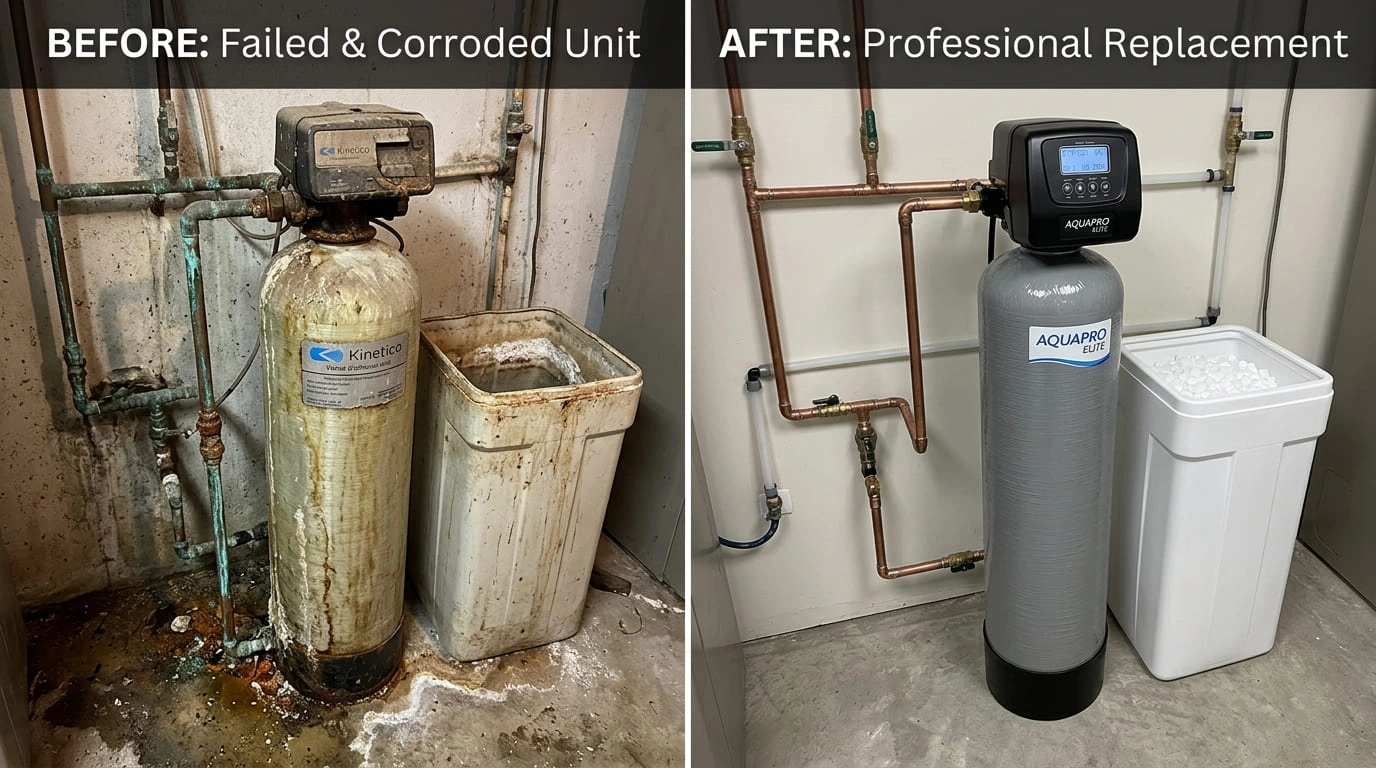
A useful before-and-after record may show:
- Before: Water hardness is unchanged through the unit. After: The effect of treatment is measured.
- Before: Salt use has unexpectedly stopped. After: The cause and regeneration behavior are assessed.
- Before: A connection is leaking. After: The completed repair is checked.
- Before: Replacement options are unclear. After: The owner understands the available scopes and costs.
Job-specific photographs and readings are more meaningful than generic transformation claims.
Repair and Replacement Methods That Fit the Equipment
Use Appropriate Components and Manufacturer Instructions
Successful service depends on using components suited to the system and following the relevant manufacturer instructions. Installation changes also need to account for plumbing connections, drainage, access, and applicable project requirements.
Manufacturer manuals provide model-specific setup and service procedures. Review the applicable Pentair softener system manual or whole-house water softener instructions for examples of model-specific requirements.
- Compatible valve, seal, injector, and bypass components.
- Suitable treatment capacity for actual demand.
- Resin specifications when media replacement is appropriate.
- Accessible isolation and service connections.
- Drain and brine-tank arrangements.
- Correct startup settings and operating checks.
A replacement should solve an identified need—not simply duplicate the size or settings of the old unit.
Can the Failed Part Be Repaired Instead?
Compare the Fault With the Condition of the Whole System
A failed component does not necessarily mean the entire system is beyond repair. Conversely, several deteriorated components, unsuitable capacity, or unavailable parts can make replacement more practical.
| Finding | Repair or maintenance option | When replacement deserves consideration |
|---|---|---|
| Salt bridge or dirty brine components | Model-appropriate cleaning and corrective service | Other substantial faults also exist |
| Serviceable injector or brine-line problem | Clean or replace affected components | Parts are unavailable or damage is extensive |
| Worn valve components | Compatible component repair or valve work | Repair cost and overall condition favor a new system |
| Deteriorated resin | Assess media replacement | Tank, valve, or other major components also need work |
| Damaged tank or housing | Evaluate safe serviceability | Structural condition makes continued use unsuitable |
| Capacity no longer suits demand | Review settings and operating requirements | Existing equipment cannot meet the application |
The best decision weighs the identified fault, the remainder of the system, parts availability, and expected value.
For Milwaukee municipal-water customers, another reasonable option may be discontinuing softening if it no longer provides a benefit you want. Milwaukee Water Works says softeners are generally unnecessary for residential use.
Water Softener Replacement in Milwaukee
There Is No Useful Single Price for Every Installation
A small component repair and a new commercial system involve different equipment, labor, and access requirements.
A Complete Estimate Should Explain
- Diagnostic charges.
- Parts and labor.
- Equipment capacity and configuration.
- Plumbing and drainage modifications.
- Removal and disposal of existing equipment.
- Startup and settings.
- Scheduling or emergency-service charges.
- Warranty terms applicable to the proposed work.
| Service category | Main pricing considerations |
|---|---|
| Diagnostic visit | Symptoms, access, and tests required |
| Component repair | Part availability and labor scope |
| Resin service | Media specifications, quantity, and equipment condition |
| Valve replacement | Compatibility and connection changes |
| Complete replacement | Equipment, installation work, removal, and startup |
| Commercial project | Capacity, access, downtime, and phased work |
Do not assume incentives, discounts, or financing apply to a project unless they are included in its written terms.
Request a Water Softener Cost EstimateDo You Need a Softener With Milwaukee City Water?
Not Every Property Needs a Water Softener
Milwaukee Water Works calls its supply moderately hard and generally considers residential softening unnecessary. Your preference and application still matter, but owning an old unit does not create an automatic need for a replacement.
Review Milwaukee Water Works information about water hardness and consider the actual purpose of your system.
Service is worth discussing when:
- Existing equipment leaks or restricts flow.
- Hardness performance no longer meets the intended purpose.
- Regeneration behavior changes unexpectedly.
- A commercial application has defined treatment requirements.
- You want to assess whether the system remains useful.
- You plan to remove or replace equipment and need plumbing changes.
A hardness result should inform the conversation—not replace it.
Commercial Plumbing and Water Treatment in Milwaukee
Plan Service Around Operating Schedules
Commercial water softener repair needs to consider operating schedules, treatment capacity, equipment requirements, and the consequences of downtime. Calat Milwau Plumbing provides a local contact for businesses and managers planning repairs or replacement.
| Commercial service | Planning focus |
|---|---|
| Performance assessment | Symptoms, water use, and treatment requirements |
| Component repair | Serviceability and parts availability |
| System replacement | Capacity, installation scope, and operating needs |
| Multi-unit planning | Equipment inventory and phased scheduling |
| Related plumbing work | Connections, leaks, and supply arrangements |
Properties may include:
- Restaurants and hospitality venues.
- Apartment and condominium buildings.
- Offices and mixed-use developments.
- Schools, churches, and community facilities.
- Commercial sites with existing water-treatment equipment.
| Project type | Important considerations |
|---|---|
| Multiple units | Consistent records and coordinated visits |
| Occupied building | Access and water-interruption planning |
| High-use application | Actual demand and regeneration requirements |
| Restricted-access site | Entry, safety, and work-area arrangements |
Why Diagnosis Matters Before Replacement
Understand the Fault Before Buying Equipment
Professional assessment can distinguish a treatment-system problem from a setting, plumbing, or usage issue. The troubleshooting process may include hardness comparisons, bypass checks, brine operation, and meter behavior.
Manufacturer manuals, such as Pentair’s softener troubleshooting guidance, describe checks that vary by model.
- Better understanding of the failure.
- A defined repair scope.
- Compatible replacement components.
- Equipment selected for actual requirements.
- Identification of related plumbing concerns.
- Clearer operating and maintenance guidance.
The goal is not always a new softener. It is an appropriate solution to the problem you have.
Safe Checks Versus Internal Repairs
Keep Clear of Pressurized, Wet, or Electrical Components
You can help the service process by recording display messages, noting salt use, and photographing accessible equipment. Internal valve work, pressure-containing components, electrical faults, and plumbing alterations call for a different level of care.
- Do not open a pressurized tank or valve assembly.
- Do not touch wet electrical controls or plugs.
- Do not force unfamiliar bypass valves.
- Do not add cleaning chemicals without model-specific guidance.
- Do not assume discolored or unusual-tasting water is harmless because a softener is installed.
For active leakage, keep clear of electrical hazards and request urgent assistance. If you know the correct shutoff and can reach it safely, shutting off the water may limit further damage.
Call for Plumbing AssistanceWater Softener Questions Milwaukee Customers Ask
Symptoms, Repairs, and Replacement
Why is my water softener not using salt?
Possible causes include a salt bridge, settings, meter faults, bypass position, or a brine-system problem. Unchanged salt level does not identify the cause by itself. Pentair’s manual outlines model-specific troubleshooting examples.
Why is the salt tank full of water?
Some water is normal in certain designs. An unusual increase can indicate refill or brine-draw problems, including an obstructed injector or affected valve components. The correct water level depends on the model. Consult its manual or arrange an assessment.
Why is my water still hard after regeneration?
The unit may have incorrect settings, an open bypass, unsuccessful brine draw, insufficient capacity, or compromised resin. Testing water before and after treatment helps establish whether the system is working. See manufacturer troubleshooting guidance.
Can you replace just the valve or resin?
Component or media replacement may be an option, depending on compatibility, parts availability, and the condition of the rest of the equipment. These options should be compared with complete replacement.
Can a water softener cause low water pressure?
Restricted media or another flow problem can affect performance. Comparing flow through and around the system, where safely possible, can help investigate whether the restriction is associated with it.
Why does my softener keep running water to the drain?
Normal regeneration includes drain flow. Persistent flow outside normal operation can indicate a valve or control problem requiring diagnosis.
Do I need to replace my softener if I have Milwaukee city water?
Not necessarily. Milwaukee Water Works says residential softeners are generally unnecessary. Consider water test results, preferences, and the purpose of the existing system before buying another.
Will a new softener fix brown water or stains?
Do not assume it will. Identify the cause of the discoloration and select treatment, if needed, for that particular problem.
Are emergency services available?
Calat Milwau Plumbing offers 24/7 emergency plumbing availability. Call with the symptoms and explain whether water is actively leaking. Call (414) 279-2050.
Know the Scope Before Approving Service
Understand the Proposed Work and Why
You should understand the proposed work, expected result, and applicable terms before deciding. Ask for the difference between correcting the current fault and addressing other recommended work.
Any service guarantee should be understood through the terms attached to your project. If a symptom returns after service, retain the invoice and contact the business to discuss reassessment and available corrective options.
Calat Milwau Plumbing836-838 N Old World 3rd St
Milwaukee, WI 53203, USA
Plumbing Credentials and Water-Treatment Installation
Credential Scopes Are Not Interchangeable
Wisconsin plumbing credentials have defined scopes. Restricted-appliance credentials cover specified water-treatment work, while restricted-service credentials concern different activities, including certain outside water and sewer work. They are not interchangeable qualifications for every project.
Wisconsin DSPS explains the restricted-appliance credential scope, which includes certain water-treatment device installations that do not require a direct connection to a drain system.
Relevant credential categories include:
- Master Plumber.
- Journeyman Plumber.
- Master Plumber–Restricted Appliance.
- Journeyman Plumber–Restricted Appliance.
- Registered apprenticeship or learner credentials with applicable supervision.
For your project, the important question is whether the assigned professional’s qualifications match the work being performed—not how many credential names appear on a page. See the DSPS restricted-appliance learner information for supervision details.
Emergency Water Softener Service in Milwaukee
Distinguish an Active Leak From Loss of Softening
A leaking softener or overflowing tank can require prompt attention. Loss of softening alone is generally a scheduling issue rather than the same emergency as uncontrolled water spreading across a floor.
When you call:
- Explain whether water is actively leaking or overflowing.
- Identify nearby electrical equipment or other hazards.
- Provide your address and equipment location.
- Describe any safe isolation steps already taken.
- Discuss the available response and next action.
Urgent situations may include:
- Uncontrolled connection or valve leaks.
- Brine-tank overflow.
- Damaged equipment releasing water.
- Significant water-supply disruption affecting an occupied property.
Documentation for a Softener-Related Incident
Keep Repair Information Separate From Insurance Decisions
If a softener leak damages the property, clear records can help explain what happened and what work was performed.
- Photographs of equipment and affected areas.
- Observed conditions and service notes.
- Diagnostic findings.
- Itemized repair or replacement invoices.
- Records of corrective work.
Coverage depends on the policy and the circumstances. A plumbing invoice does not guarantee reimbursement; discuss claim requirements directly with your insurer.
Parts and Workmanship Warranty Terms
Manufacturer Coverage and Contractor Terms Are Separate
Warranty coverage should identify what is protected, who provides it, and how a claim is made. A manufacturer’s equipment warranty and a contractor’s workmanship terms are separate matters.
| Coverage category | What to review |
|---|---|
| Workmanship | Covered labor, duration, and exclusions |
| Replacement parts | Supplier or manufacturer terms |
| New equipment | Covered components and registration requirements |
| Service records | Invoice, model, serial number, and work description |
| Claim procedure | Contact method and required documentation |
Ask for the terms associated with your selected repair or installation. Do not assume all components carry the same coverage or that maintenance needs are included.
Five Equipped Service Vans Serving Milwaukee
Preparation Starts With Your Equipment Information
Calat Milwau Plumbing’s supplied business profile includes five equipped service vans and a team of 50 professionals. Those resources support service coordination across residential and commercial plumbing work.
For water-treatment calls, preparation starts with the equipment information:
- System brand and model.
- Photographs of the installation.
- Display messages or visible symptoms.
- Access restrictions.
- Previous repairs.
Some jobs require model-specific parts or ordered equipment. Providing details before the visit helps distinguish a likely diagnostic call from a planned repair or replacement.
Payment Questions for Water Softener Replacement
Understand the Full Project Budget
A major replacement or multi-unit project deserves a clear budget. Discuss payment arrangements before approving work, and do not assume financing is automatically included.
If a financing arrangement is offered, review:
- The financing provider.
- Eligibility requirements.
- Interest rate and fees.
- Promotional conditions.
- Payment schedule.
- Total amount payable.
For commercial work, separating necessary repairs from optional upgrades can also help define the immediate project budget.
Choose a Plumbing Team by Relevant Capability
Look for Evidence That Applies to Your Project
Recognition can provide context, but it should not replace an assessment of whether a provider can service your equipment and explain the work.
When choosing a company, look for:
- Relevant plumbing qualifications.
- Experience with the equipment type.
- A clear diagnostic scope.
- Written estimates.
- Understandable warranty terms.
- Responsive communication.
For your softener, the most important outcome is appropriate service—not an award label.
Discount Questions for Eligible Customers
Confirm Eligibility Before Work Begins
When requesting service, mention any senior, military, or veteran eligibility and ask whether a current offer applies to the proposed work. Do not assume that every repair or replacement qualifies.
Discuss:
- Available customer discounts.
- First-time customer offers.
- Repair credits, if applicable.
- Eligible service categories.
- Exclusions and combination rules.
Any applicable discount should appear in the estimate rather than remain an informal expectation.
Water Softener Service Hours in Milwaukee
Emergency Contact and Routine Scheduling
Calat Milwau Plumbing offers 24/7 availability for emergency plumbing requests. Routine assessments and replacement installations can be scheduled around the equipment, property access, and work required.
| Day | Availability |
|---|---|
| Monday | 24 hours |
| Tuesday | 24 hours |
| Wednesday | 24 hours |
| Thursday | 24 hours |
| Friday | 24 hours |
| Saturday | 24 hours |
| Sunday | 24 hours |
- Phone: Call (414) 279-2050
- Email: calatmilwauplumbing@gmail.com
- Website: Calat Milwau Plumbing
Emergency availability does not mean every replacement model or specialty part is available immediately.
What to Ask Before Hiring a Softener Repair Company
Compare Diagnosis, Scope, and Terms
A meaningful comparison looks at diagnosis, serviceability, scope, and terms—not unsupported assumptions about another provider.
| Comparison point | What to ask Calat Milwau Plumbing | What to ask any provider |
|---|---|---|
| Diagnosis | What will the assessment cover? | Is diagnosis separate from a sales consultation? |
| Equipment compatibility | Can this model be serviced? | Are suitable parts available? |
| Repair options | Can the affected component be repaired? | What alternatives to full replacement exist? |
| Pricing | What is included in the estimate? | Are removal and modifications extra? |
| Availability | What response or appointment is available? | Is emergency service offered? |
| Warranty | Which terms apply to this work? | Who handles parts and labor claims? |
| Related plumbing | Can associated leaks be addressed? | Is additional trade work required? |
Choose the proposal that clearly connects the findings to the recommended work.
Contact Calat Milwau Plumbing for Water Softener Service
Tell Us What Your System Is Doing
Whether your softener has stopped using salt, keeps draining, leaks, or leaves you wondering whether replacement is worthwhile, start with the symptoms. We can discuss your service request and arrange the next step for your Milwaukee home or commercial property.
When contacting us, provide the brand and model, your address, the problem’s duration, and whether there is an active leak.
- Phone: Call (414) 279-2050
- Email: calatmilwauplumbing@gmail.com
- Service page: Water Softener Repair & Replacement
- Address: 836-838 N Old World 3rd St, Milwaukee, WI 53203, USA
Helpful Details to Share
- System brand, model, and approximate age.
- Whether salt use or regeneration has changed.
- Display messages or unusual drain flow.
- Water hardness concerns or test results.
- Any active leak, overflow, or access limitation.
Contact Calat Milwau Plumbing for water softener repair in Milwaukee and a practical discussion of repair, replacement, or the future of your existing system.