Sump Pump Repair and Replacement in Milwaukee, WI — Available 24/7
Milwaukee County sump pump services for homes and commercial properties
A sump pump that will not kick on, runs nonstop, or fails to lower the water level needs more than guesswork. Calat Milwau Plumbing provides sump pump repair in Milwaukee, WI, with practical guidance on whether the problem involves the pump, float switch, check valve, discharge piping, or drainage system feeding the basin.
Serving Milwaukee since 1990, our business brings together 50 skilled professionals and five equipped service vans to support homeowners, landlords, and commercial property managers. From troubleshooting an existing system to replacing a failing primary pump or discussing backup protection, we help you understand the work before moving forward.
Call +1 (414) 279-2050 for service scheduling, emergency assistance, and a clear explanation of your options.
- Primary pump troubleshooting, repair, and replacement.
- Float-switch, check-valve, and discharge-pipe evaluation.
- Residential and commercial sump pump service.
- 24/7 emergency availability.
If standing water surrounds your pump or electrical equipment, stay out of the affected area and call for professional assistance. MMSD foundation drain and sump-pump guidance.
Request Sump Pump Service
Describe the pump, water level, and any active leak.
Water spreading? Call (414) 279-2050.
Local Experience With a Diagnosis-First Approach
Find out what failed before choosing the repair
The right repair starts with identifying what failed. A noisy pump does not automatically need replacement, and a wet basement does not automatically mean the pump is undersized. Discharge obstructions, returning water, loose piping, and clogged foundation drains can create different symptoms that require different solutions. MMSD foundation-drain guidance.
Calat Milwau Plumbing combines local plumbing experience with straightforward communication. We explain the condition of your equipment, identify the proposed scope, and help you compare a targeted repair with a replacement or broader drainage correction.
Helping Property Owners Throughout the City and Nearby Communities
Assess the property’s actual drainage arrangement
Whether you manage a building near Fiserv Forum or own a home in Bay View, the important question is how water reaches your basin and where it goes after pumping. Our service focuses on the property’s actual drainage arrangement—not assumptions based on its neighborhood.
Older basement systems may need a different assessment from newer installations, particularly where foundation drains or Palmer valves are involved. MMSD identifies these older connections as an important part of the region’s basement-drainage history. Read about Milwaukee foundation drains and Palmer valves.
Milwaukee RiverWalk
Local downtown reference point.
Fiserv Forum
Near the Deer District and business areas.
Milwaukee Public Market
Historic Third Ward reference point.
Pabst Theater
Downtown landmark.
Menomonee River Valley
Business and industrial corridor.
Diagnosis That Considers the Complete Pumping System
Check controls, piping, and discharge—not just the motor
Replacing a pump without checking its controls and discharge path can leave the original problem unresolved. A functioning pump may struggle because water cannot leave the pipe, flows back into the basin, or returns toward the foundation after discharge. MMSD sump-pump troubleshooting.
Our sump pump service looks beyond the motor. We assess the basin, float movement, accessible piping, check valve, discharge arrangement, and operating behavior before recommending corrective work.
- Primary pump and control troubleshooting.
- Existing sump crock and access assessment.
- Check-valve and discharge-piping evaluation.
- Replacement and backup-system recommendations.
- Clear separation between pump work and broader basement-drainage work.
Assess the Full System
A pump, float, check valve, discharge route, and incoming foundation-drain water each affect system behavior.
Why Is Your Basement Wet Even With a Sump Pump?
A pump removes water collected in its basin—not every source of basement water
A sump pump removes water collected in its basin. It cannot solve every source of basement water, and it cannot work properly if its power, controls, or discharge path fail. MMSD identifies distinct issues including nonstop running, rapid cycling, blocked discharge, and basement seepage with a dry basin. Read MMSD sump-pump and foundation-drain guidance.
Tell us what you can observe from a safe, dry location:
Full Basin, No Start
The pump will not turn on as the basin fills.
Runs Without Lowering Water
The motor runs, but the level does not drop.
Water Returns
Water rushes back after the pump shuts off.
Runs With Empty Basin
The pump continues when the pit appears empty.
Leaking Discharge
Water escapes from piping inside the basement.
Wet Floor, Dry Pit
Basement floor is wet while the sump pit remains dry.
These symptoms help guide inspection; they do not establish the cause by themselves.
Prepare the System Before Snowmelt and Heavy Rain
Test regularly and follow the equipment instructions
Routine service helps identify operating problems before an urgent pumping situation develops. MMSD recommends testing regularly and specifically identifies spring, before snowmelt, as a useful time to check the system. Maintenance should follow equipment instructions and the property’s operating conditions rather than an assumed universal certification schedule. MMSD sump-pump maintenance guidance.
| Maintenance Task | What It Addresses | Suggested Timing | Practical Value |
|---|---|---|---|
| Visual inspection | Visible damage, leaks, and accessible component condition | During service and after a reported problem | Identifies issues needing investigation |
| Operational test | Automatic start, water removal, and shutoff | Regularly, following manufacturer guidance | Checks basic operation |
| Float assessment | Obstructions and movement | During maintenance or diagnosis | Helps identify control problems |
| Discharge review | Visible leaks, outlet condition, and returning water | Seasonally and after changes | Helps identify restricted or recirculating flow |
| Backup-system check | Battery, charger, alarm, and backup operation | Following system instructions | Assesses backup readiness |
| Service documentation | Findings, work completed, and recommendations | After the visit | Supports future decisions |
Practical Maintenance Reminders
- Schedule maintenance before demanding weather, snowmelt, or heavy rain.
- Review operation after unusually frequent cycling.
- Keep the basin accessible and retain service records.
- Address new leaks or alarm conditions promptly.
Commercial properties should include checks in facility-maintenance procedures. Frequency and cost depend on equipment, operating conditions, access, and repairs needed.
Who We Help
Homeowners, landlords, and facility managers
Calat Milwau Plumbing supports residential and commercial properties with installed groundwater pumping systems. Each visit should account for the consequences of failure, equipment accessibility, and the people responsible for authorizing work.
Homeowners
Protecting basement storage and finished spaces.
Landlords
Maintaining rental-property equipment.
Condominium & Multifamily Managers
Coordinating shared building systems.
Businesses
Basement mechanical or storage spaces.
Facility Managers
Responsible for multiple pumping systems.
Buyers & Sellers
Assessing existing equipment condition.
For broader building needs, explore commercial plumbing services.
Milwaukee Conditions Affect Pumping Performance
The system may behave differently when incoming water increases
A pump that performs adequately during ordinary conditions may behave differently when incoming water increases or discharge becomes obstructed. MMSD highlights snowmelt preparation, winter ice blockages, recirculation, and storm-related power loss as relevant sump-pump concerns. MMSD foundation-drain and sump-pump information.
If the pump starts cycling more frequently, the solution may involve incoming water or discharge routing—not simply a larger replacement unit. See MMSD troubleshooting guidance.
Choose Equipment Around the Installation
The basin, discharge arrangement, incoming water, and backup needs all matter
An appropriate replacement should work with the overall system, not just meet a single equipment specification.
| System Type | Typical Role | Main Consideration |
|---|---|---|
| Submersible primary pump | Main groundwater removal from the basin | Compatibility with the basin and required performance |
| Pedestal primary pump | Main pumping with motor positioned above basin | Available space, installation layout, and equipment requirements |
| Battery backup pump | Supplemental pumping during qualifying primary-pump or power failures | Battery condition, runtime, and backup capacity |
| Water-powered backup | Backup operation using municipal water pressure | Supply pressure, installation requirements, and water consumption |
MMSD explains that battery runtime is limited and water-powered performance depends on available municipal supply. A water-powered backup is not suitable for a private-well arrangement that loses its water supply during an outage. MMSD backup-pump guidance.
A groundwater sump pump is not interchangeable with sewage-handling equipment. Tell us if the basin receives wastewater so the service request can be assessed appropriately.
Our 6-Step Sump Pump Service Process
Know what to expect from your service visit
Initial Call and Assessment
Describe the symptom, water level, access conditions, and whether electrical hazards or an outage are present.
On-Site Inspection
Assess the pump, basin, float, check valve, and accessible discharge arrangement.
Diagnostic Work
Evaluate operation and distinguish pump fault from control, piping, power, or incoming-water issues.
Repair or Replacement Proposal
Explain the findings, recommended work, alternatives, and scope before authorization.
Service and Operational Checks
Complete approved work and check start, pumping, shutoff, and visible connections where conditions permit.
Handover and Follow-Up
Explain the equipment, provide service records, and discuss maintenance or additional investigation.
Electrical alterations and broader drainage work should be identified separately when they fall outside the approved pump-service scope.
What’s Included in Sump Pump Service?
Separate diagnosis, repair, and replacement deliverables
Not every visit requires a new pump, and not every replacement requires a new basin. The proposal should identify what is being repaired, what is being replaced, and which optional or additional items are included.
Depending on the Approved Scope, Service May Include:
- Assessment of the reported operating problem.
- Inspection of relevant accessible components.
- Explanation of diagnostic findings.
- Approved repair or replacement work.
- Applicable operational checks after service.
- Equipment and maintenance guidance.
- Service documentation and itemized invoice.
Confirm Additional Work
New check valves, discharge modifications, battery backups, excavation, concrete restoration, electrical upgrades, and water-damage cleanup should be expressly included in the scope rather than assumed.
Ask which equipment, diagnostics, operational checks, and exclusions are included in writing.
Sump Pump Service With Clear Recommendations
Understand the fault, proposed repair, and next steps
Our goal is to make a sump pump decision easier: understand what failed, review the repair options, and know what happens next.
Diagnosis-First Service
Review symptoms and system behavior before recommending work.
Repair or Replacement Options
Consider equipment condition and the actual fault.
Whole-System Attention
Consider controls, valves, piping, and discharge.
Written Scope
Understand the proposed work before authorizing it.
Residential & Commercial
Coordinate service to fit the type of property.
24/7 Availability
Call about urgent water and pump concerns.
What Does a Meaningful Sump Pump Improvement Look Like?
Understand what changed—and what the test can show
A useful transformation explains what was wrong and what changed. A new-looking installation is not proof that every basement-water issue has been solved.
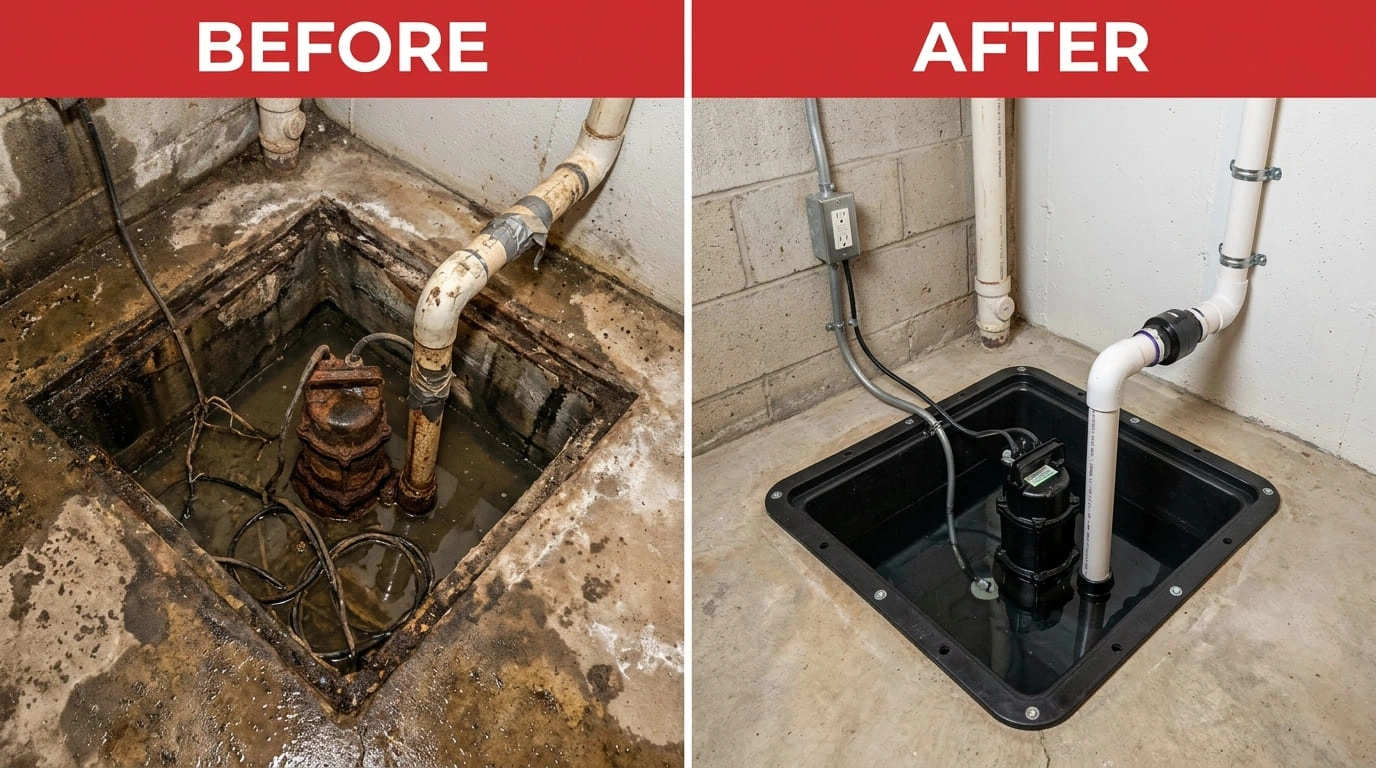
Examples of Service Outcomes
- Before: A pump does not start automatically. After: The identified fault is corrected and automatic operation is checked.
- Before: Water returns through the discharge pipe. After: The relevant valve or piping issue is addressed and behavior reassessed.
- Before: A primary pump has no outage protection. After: An approved backup arrangement is installed and its operation explained.
- Before: The owner does not understand the system. After: The owner receives findings and maintenance guidance.
Performance checks demonstrate operation under the conditions tested; they do not guarantee protection against every future storm.
Build the Repair Around the Whole System
Basin, discharge route, controls, and operating needs matter
A replacement should be compatible with the basin and installed according to equipment instructions and applicable requirements. We consider accessible piping, service access, float clearance, and the discharge arrangement as part of the proposed work.
Suitable Pump Selection
Select equipment suited to the installation and approved scope.
Float Clearance
Allow for unobstructed movement of the pump control.
Valve & Piping Layout
Consider check-valve and piping configuration.
Secure Connections
Address accessible connections and piping support.
Discharge Assessment
Review the outlet to reduce returning water.
Operational Checks
Check operation after approved installation work.
MMSD advises against routing sump discharge into a basement floor drain or wash tub. It also recommends directing outdoor discharge away from the house and consulting the local plumbing inspector when the connection is uncertain. MMSD foundation-drain guidance.
Choose the Work That Addresses the Actual Fault
A wet basement or noisy pump does not always mean replacement
A repair can be sensible when the problem is isolated and the remaining equipment is in suitable condition. Replacement may be more appropriate when the pump itself is damaged, unreliable, or unsuitable for the assessed installation.
| Finding | Repair or Correction May Suit | Replacement May Suit |
|---|---|---|
| Obstructed float | Remove the obstruction and assess controls | When control damage or other pump faults justify it |
| Faulty check valve | Replace the affected valve | Not automatically a reason to replace the pump |
| Leaking discharge joint | Repair the relevant connection | Only if the pump also requires replacement |
| Damaged housing or failed motor | Assess repair feasibility and cost | Often the more practical option |
| Repeated operating failures | Identify the underlying cause | When the pump remains unreliable after assessment |
| Inadequate pumping performance | Evaluate discharge and incoming water first | When capacity assessment supports a change |
| Wet basement with a dry basin | Investigate the drainage system | A pump swap alone may not address the problem |
MMSD troubleshooting guidance supports distinguishing these conditions rather than treating every symptom as pump failure. Review MMSD sump-pump troubleshooting.
Replacement becomes a stronger option when equipment condition, repeated faults, repair cost, and the consequences of another failure outweigh the benefit of a component repair.
How Much Does Sump Pump Replacement Cost in Milwaukee?
Equipment and installation requirements shape the price
Sump pump repair and replacement costs depend on the equipment and work required. Replacing a primary pump in a usable existing basin is different from installing a new basin, altering foundation drains, restoring concrete, and arranging electrical work.
Main Cost Drivers
- Pump type and required performance.
- Condition of the existing basin.
- Check-valve and discharge-pipe work.
- Backup equipment and installation.
- Access and removal requirements.
- Electrical or drainage modifications.
- Scheduled versus emergency service.
Request an Estimate
Ask for an itemized proposal so you can compare equivalent scopes. Any available incentives should be treated separately from the base service price.
Request a Sump Pump EstimateCall (414) 279-2050 to discuss your system.
| Service Type | Estimate Considerations |
|---|---|
| Diagnostic visit | Access, symptoms, and testing scope |
| Component repair | Parts availability and labor |
| Primary pump replacement | Equipment, removal, installation, and related components |
| Primary pump plus backup | Backup type, battery or supply requirements, and controls |
| New-system installation | Basin, drainage connections, concrete, discharge, and electrical work |
When Should You Request Sump Pump Service?
Check the equipment when its behavior changes
Arrange service when the pump behaves differently or fails an operational check. The objective is to determine whether repair, replacement, or drainage investigation is needed.
No Automatic Start
The pump does not activate as the basin fills.
Water Level Stays High
The motor runs, but the basin level does not lower.
Runs With an Empty Basin
The pump continues cycling unnecessarily.
Water Returns
Water flows back through the discharge after shutoff.
New Discharge Leak
Accessible discharge piping begins leaking.
Backup Fault
A backup alarm or system check indicates a problem.
Repeated Failures
The equipment has unresolved operating problems.
If the basement is wet but the sump pit is dry, foundation drains may be clogged. That condition needs investigation rather than an automatic recommendation for a larger pump. MMSD foundation-drain guidance.
Support for Facilities, Rental Buildings, and Property Portfolios
Defined scope and coordination for occupied properties
Commercial plumbing work requires more than equipment access. Managers need a defined scope, approval process, service coordination, and records that explain the completed work.
Calat Milwau Plumbing provides commercial plumbing support for buildings with applicable groundwater pumping systems. We help distinguish an individual equipment fault from a wider drainage or building-system issue.
| Commercial Service | Scope |
|---|---|
| System assessment | Review reported faults and accessible equipment |
| Component repairs | Address approved control, valve, or piping problems |
| Pump replacement | Select and install suitable replacement equipment |
| Backup evaluation | Review supplemental pumping needs |
| Maintenance planning | Organize checks around equipment and facility requirements |
Property Types
- Multifamily buildings
- Offices and retail properties
- Hospitality premises
- Community facilities
- Warehouses
Project Coordination
- Coordinate access with an authorized representative.
- Separate urgent work from planned improvements.
- Identify equipment and location in service records.
- Define multi-system projects in a proposal.
Why Professional Sump Pump Diagnosis Matters
The value is more than installing a new unit
Professional service identifies what prevents the existing system from working and helps select a suitable correction.
Distinguish System Faults
Separate equipment failure from discharge restrictions.
Review Controls
Identify controls or valves that may cause repeated cycling.
Assess Replacement
Decide whether the condition supports a new pump.
Understand Backup Limits
Review supplemental protection and its capabilities.
Identify Drainage Concerns
Explain remaining basement-water issues.
Keep Useful Records
Document the work performed and recommendations.
MMSD identifies basement-water problems that cannot be resolved by replacing the pump alone. Review its foundation-drain guidance.
Do Not Enter Standing Water to Troubleshoot the Pump
Water near electrical equipment can create a serious shock hazard
Milwaukee’s Health Department warns against using wet electrical equipment, and MMSD advises calling a professional when standing water surrounds the sump pump or electrical fixtures. MMSD safety guidance | City of Milwaukee flood-cleanup safety.
Call emergency services for an immediate threat to life, fire, or suspected gas danger. For urgent pump-service assistance, contact our team from a safe location.
Sump Pump Repair & Replacement FAQs
Clear guidance on faults, replacement, backups, and drainage
Why is my sump pump running nonstop?
Continuous operation can result from high incoming water, a control problem, discharge obstruction, or water returning toward the foundation. The basin level and discharge behavior help distinguish the possibilities. MMSD troubleshooting guidance.
Why won’t my sump pump kick on?
Possible causes include loss of power, an obstructed or faulty float, or pump failure. If there is pooled water near electrical equipment, do not troubleshoot it yourself.
Why is the pump running but not lowering the water?
The discharge may be obstructed, or the pump may not be keeping up with incoming water. Inspection is needed before deciding whether to repair piping or change equipment.
Why does water rush back into the sump pit?
A faulty or missing check valve can allow water in the discharge pipe to return after shutoff, causing rapid cycling.
Does a louder pump always need replacement?
No. Loose piping or contact with other pipes or ducts can transmit noise. The source should be identified before replacing the pump.
What happens when the power goes out?
An electrically powered primary pump stops unless a suitable backup power or pumping arrangement is available. Battery and water-powered backups have different capacity and operating limitations.
How long will a battery backup run?
Runtime depends on the battery and how much pumping is required. It is not a fixed number of hours that applies to every property. MMSD notes that battery systems have limited runtime.
Why is my basement wet when the sump pit is dry?
Clogged foundation drains are one possible explanation. The water may not be reaching the basin, so replacing the pump may not solve the seepage.
What is a Palmer valve?
It is an older valve arrangement that allowed foundation-drain water into the sanitary sewer. MMSD describes problems with corroded or stuck flaps and provides information about disconnection incentives.
Do I need a plumber or a waterproofing contractor?
Pump, valve, and accessible discharge faults are different from structural or extensive foundation-drain problems. Begin with an assessment that identifies the likely scope instead of assuming every wet basement needs a complete waterproofing project.
Does sump pump replacement include a new check valve?
Only if the approved proposal includes it. Ask for the pump, valve, piping, backup equipment, and other work to be listed separately.
Can you help during a sump pump emergency?
Calat Milwau Plumbing offers 24/7 emergency availability. Call +1 (414) 279-2050 and explain the water level, symptoms, and access conditions.
Clear Recommendations From the First Call Through Handover
Understand what was completed and what concerns remain
Calat Milwau Plumbing focuses on explaining the problem, defining the work, and helping you understand the serviced system. Your proposal and service records should make clear what was completed and what additional concerns remain.
If an issue develops after service, contact us with the invoice and equipment information so the concern can be reviewed against the applicable service and warranty terms.
Credentials Should Match the Work Being Performed
Ask who is responsible for each part of a project
Sump pump projects can involve plumbing, drainage, and electrical requirements. The people performing each part of the project should have qualifications appropriate to that work.
Master Plumber
Credential category relevant to applicable plumbing work.
Journeyman Plumber
Credential relevant to assigned plumbing responsibilities.
Registered Plumbing Apprentice
Work must follow applicable supervision requirements.
Restricted Plumbing Credentials
Authorized scope applies to relevant work.
When reviewing a proposal, ask who is responsible for plumbing work, electrical alterations, and any required inspection coordination. A credential title should not be treated as authorization for every part of a project.
Call When Water Rises or the System Stops Responding
Start from a safe location and describe what the pump is doing
An urgent pump problem may involve a full basin, failed controls, restricted discharge, or loss of power. Start with safety, then describe the symptom clearly so the service request can be assessed.
Call +1 (414) 279-2050 from a safe location.
Explain whether water is rising and whether the pump is running.
Mention electrical exposure, an outage, or a backup alarm.
Provide the property address and access information.
Review proposed response and on-site findings.
Emergency Pump Service
Call if water is rising or the pump has stopped unexpectedly.
Call (414) 279-205024/7 emergency availability
Rising Water
A full basin or water spreading on the floor.
Pump Failure
A system stops responding during operation.
Backup Alert
A backup alarm or system check indicates trouble.
Flood cleanup and building drying are separate from restoring pumping operation.
Keep Clear Records of Findings and Corrective Work
Organize information for your insurer or property manager
If you intend to notify your insurer, retain photos taken from a safe location, service records, invoices, and relevant equipment information. Ask what documentation is available for your service visit.
Initial Observations
Reported symptoms and visible conditions.
Equipment Condition
Accessible equipment findings.
Completed Work
Identified faults and repairs performed.
Equipment Details
Installed pump or component information.
Invoices & Recommendations
Itemized work and recommended follow-up.
Coverage depends on policy terms, exclusions, endorsements, and the insurer’s assessment. A repair invoice does not establish that water damage is covered.
Sump Pump Warranty Details
Separate equipment coverage from workmanship terms
Warranty protection should be explained in the proposal or service documents. Manufacturer coverage and company workmanship coverage can have different conditions.
| Coverage Category | What to Review |
|---|---|
| Manufacturer equipment warranty | Covered components, claim process, and exclusions |
| Workmanship coverage | Applicable installation or repair terms |
| Replacement parts | Part-specific coverage |
| Service records | Equipment details and documentation supporting a claim |
Retain invoices and follow equipment maintenance instructions. Do not assume warranty coverage includes water damage, backup batteries, electrical faults, or every future service visit.
Resources Supporting Local Service Requests
Equipment and parts depend on the pump and reported fault
Calat Milwau Plumbing’s five service vans support residential and commercial plumbing operations. Equipment and parts requirements vary by the pump, installation, and reported fault.
- Diagnostic and inspection equipment.
- Plumbing tools for accessible connections.
- Suitable replacement components.
- Pump and backup equipment selected for the approved scope.
- Materials for authorized discharge-pipe corrections.
We assess the work rather than assume every system can be restored with the same stocked parts. Specialty equipment, broader drainage work, or electrical alterations may require separate coordination.
Milwaukee Plumbing Team
Supporting properties across Milwaukee and nearby communities.
Discuss Your Pump SystemPayment Options for Major Sump Pump Repairs
Discuss payment arrangements before authorizing work
A simple repair and a complete new-system installation have different financial requirements. Begin with a written scope so you understand the primary pump, backup equipment, piping, basin work, and any separately arranged electrical work.
Payment Methods
Ask which methods are accepted.
Available Arrangements
Discuss any currently available payment arrangements.
Financing Terms
Review interest, fees, eligibility, and repayment terms.
Separate essential corrective work from optional upgrades. Do not assume financing is included with an estimate or approved automatically.
Evaluate Recognition Alongside the Actual Proposal
Practical service standards matter to the project
Third-party recognition can be one part of choosing a plumbing provider, but it does not replace an assessment of proposed work. For a sump pump project, practical service standards matter directly to the outcome.
Clear Explanation
Understand the reported problem.
Defined Scope
Know what repair or replacement includes.
Suitable Equipment
Consider the installation and approved scope.
Operational Checks
Review operation after service.
Accurate Records
Retain details of completed work.
Choose Based on the Work
Look for an appropriate scope, clear communication, and evidence—not an award graphic alone.
Sump Pump Offers and Service Discounts
Review eligibility and terms before scheduling
Contact Calat Milwau Plumbing to ask about current offers and whether senior, military, or veteran pricing is available for your project. Our supplied special-offer categories include first-time customer discounts, tiered repair service credits, and battery-backup sump pump promotions.
An equipment promotion and a public incentive program are separate offers with separate requirements.
Sump Pump Service Hours in Milwaukee
24/7 availability for urgent service requests
Calat Milwau Plumbing offers around-the-clock emergency availability. For planned maintenance, replacement, or commercial projects, call to discuss scheduling and access requirements.
| Day | Availability |
|---|---|
| Monday | 24 Hours |
| Tuesday | 24 Hours |
| Wednesday | 24 Hours |
| Thursday | 24 Hours |
| Friday | 24 Hours |
| Saturday | 24 Hours |
| Sunday | 24 Hours |
Contact Calat Milwau Plumbing
Call to discuss current response and appointment availability; 24/7 access does not mean every request has the same arrival time.
Look Beyond the Pump Price
Estimates may include very different work
Compare the equipment, diagnosis, installation scope, backup options, and exclusions before choosing.
| Feature | Calat Milwau Plumbing Service Focus | What to Ask Any Provider |
|---|---|---|
| Diagnosis | Identify reported fault and relevant system conditions | Will you assess controls and discharge before recommending replacement? |
| Scope | Explain proposed work before authorization | What is included and excluded? |
| Replacement | Discuss equipment suitability | Why is this pump appropriate for the installation? |
| Backup options | Review supplemental protection | What are its capacity and runtime limitations? |
| Documentation | Retain findings and service records | What records will I receive? |
| Availability | 24/7 emergency availability | What response is available for my address now? |
| Broader plumbing | Residential and commercial service capability | Who handles work outside the pump scope? |
The best proposal addresses the identified problem with a clear, appropriate scope—not necessarily the lowest equipment price.
Contact Calat Milwau Plumbing About Your Next Step
Tell us what the pump is doing and what you can safely observe
If your pump will not kick on, keeps running, or cannot lower the water level, call with the symptoms you can safely observe. If you are planning replacement, ask for an assessment that separates the primary pump from backup equipment, discharge corrections, and broader drainage work.
Sump Pump Service Contact
+1 (414) 279-2050
Sump Pump Repair & Replacement
836–838 N Old World 3rd St, Milwaukee, WI 53203, USA
Helpful Information for Your Call
- Water level and whether it is rising
- Whether the pump is running or silent
- Any outage, alarm, or electrical exposure
- Property address and access details
Get clear guidance and professional sump pump repair in Milwaukee, WI, from Calat Milwau Plumbing.
Request Sump Pump Service
Describe the symptoms, equipment, address, and access needs.
Sump Pump Service Areas
Calat Milwau Plumbing takes sump pump service requests across Milwaukee and nearby communities. View service areas.