Bathtub-to-Shower Conversion in Milwaukee, WI — A Better Bathroom Starts Here
Greater Milwaukee Shower Conversion Services for Comfortable, Practical Everyday Use
An unused bathtub should not stand between you and a bathroom that works better for your household. Calat Milwau Plumbing provides tub-to-shower conversion in Milwaukee, WI, helping homeowners plan bathtub removal, shower installation, plumbing changes, and easier-entry options around their space and budget.
Whether you want a standing shower, a low-threshold base, or a complete update to an older tub enclosure, start with a clear discussion of what can stay, what needs replacing, and what the project includes. Our business brings a history dating to 1990, a team of 50 professionals, and five equipped service vans to its plumbing operations.
Call (414) 279-2050 to discuss your conversion. Request an assessment for your shower project. Emergency plumbing assistance is available 24/7; conversion appointments and installation schedules are arranged around the project.
- Shower layouts planned around your existing bathroom.
- Plumbing, drainage, and permit considerations addressed before installation.
- Options for easier entry, seating, and handheld showerheads.
- Residential and commercial plumbing support for related improvements.
Milwaukee Tub-to-Shower Conversion Services with Clear Project Planning
Know the Scope Before Your Bathtub Comes Out
A successful conversion starts with more than choosing a wall color. You need to understand the plumbing work, installation method, bathroom downtime, and potential conditions hidden behind the existing enclosure.
Calat Milwau Plumbing approaches your project as a complete bathroom-plumbing decision. We discuss your goals, assess the existing layout, and explain the work needed to turn the tub area into a practical shower. Learn more about our business and plumbing team.
- Established in 1990.
- A business team of 50 professionals.
- Five equipped service vans supporting plumbing operations.
- Around-the-clock availability for emergency plumbing calls.
- One point of contact for conversion questions and related plumbing needs.
Shower Conversion Across Milwaukee Neighborhoods and Nearby Communities
Bathroom Projects Near Downtown, the East Side, and Milwaukee’s Lakefront
An upstairs bathroom, a downtown condominium, and a duplex can present different access and scheduling needs. Tell us about stairs, parking, building rules, shared water shutoffs, and whether the bathroom is your household’s only bathing space.
Our Milwaukee County shower conversion service begins with the property—not assumptions about its neighborhood. Whether you are near Fiserv Forum, the Milwaukee RiverWalk, or the Historic Third Ward, we plan around the actual bathroom and building conditions.
Milwaukee neighborhoods
Bay View, Riverwest, Walker’s Point, Westown, Lower East Side, and Brewers Hill.
Nearby communities
Shorewood, Wauwatosa, West Allis, West Milwaukee, St. Francis, Waukesha, Racine, and Kenosha.
Local project settings
Homes, condominiums, duplexes, rental properties, and buildings with bathing facilities.
Tub Removal and Shower Installation Require More Than Cosmetic Work
Plumbing, Waterproofing, and Layout Must Work Together
Replacing a bathtub with a shower changes how the bathing area collects and drains water. The existing drain location, shower base, wall assembly, valve, and enclosure need to function as a coordinated installation.
Our planning addresses those connections before finishes are selected. We also discuss whether related bathroom remodeling requires additional trades or work outside the immediate tub footprint.
- Assess the existing drain, trap, supply connections, and valve.
- Match the shower base to the proposed layout.
- Plan wall support for selected seating and grab-bar features.
- Identify surrounding floor, ceiling, or wall repairs.
- Explain which work belongs in the conversion scope.
Is Your Bathtub Making Daily Use More Difficult?
Separate Renovation Goals from Existing Plumbing Problems
Some homeowners want a shower because they rarely use the tub. Others struggle with stepping over the tub wall, cleaning an aging surround, or working around a cramped enclosure. Existing leaks, loose finishes, or noisy fixtures add another layer to the decision.
A conversion should address those concerns without replacing sound components unnecessarily. If keeping your bathtub and updating the surround better fits your goals, that alternative deserves consideration. For a specific fixture or enclosure issue, explore our shower repair and replacement options.
- Difficult entry or an inconvenient bathing layout.
- An unused bathtub occupying the main shower area.
- Worn finishes that are hard to maintain.
- Existing leaks or drainage concerns requiring investigation.
- A need for seating, support features, or more accessible controls.
Keep Your New Shower Clean, Functional, and Well Maintained
Practical Aftercare Instead of Unnecessary Annual Certification
A residential shower conversion is not an annual device-certification service. After installation, the focus is on appropriate cleaning, checking visible wear, and following the instructions for your selected products.
| Maintenance task | Description | Typical timing | Purpose |
|---|---|---|---|
| Surface cleaning | Use cleaners approved for the wall and base materials | According to product guidance | Protect the finish |
| Drain care | Remove accessible hair and debris | As needed | Support normal drainage |
| Joint inspection | Look for separation, cracking, or deterioration | Periodically | Identify potential water-entry points |
| Door and hardware checks | Check operation and visible wear | According to manufacturer instructions | Maintain proper use |
| Plumbing assessment | Investigate persistent leaks, noises, or slow drainage | When symptoms appear | Address the underlying issue |
- Before extended travel, check for dripping fixtures or visible leaks.
- After heavier household use, give drainage and cleaning extra attention.
- Address deteriorated joints rather than repeatedly covering them with new sealant.
Service frequency depends on condition and product guidance, not a blanket annual-certification requirement. Maintenance and repair costs depend on the issue, access, and parts involved.
Keep product instructions, invoices, and warranty documents together. Avoid abrasive cleaners unless the manufacturer permits them.
Who Can Benefit from a Tub-to-Shower Conversion?
Homeowners, Rental Owners, and Multi-Unit Property Managers
The right shower depends on who uses it. A household seeking easier entry may need different features from a landlord updating a rental bathroom or an owner preparing a guest bathroom for regular use.
- Homeowners replacing a seldom-used bathtub.
- Older adults seeking a lower entry and practical support features.
- Households planning seated shower use.
- Condominium owners coordinating work with building management.
- Duplex and apartment owners updating bathing facilities.
- Hospitality and residential-property managers planning larger projects.
We discuss the user’s needs alongside the property’s installation constraints.
How Do Local Conditions Affect Your New Shower?
Focus on Moisture Control, Cleaning, and Existing Materials
Milwaukee Water Works describes the city’s water as moderately hard and states that water softeners are not necessary for residential use. A new shower does not automatically create a need for a whole-home softener. See Milwaukee Water Works water-quality information.
Bathroom performance also depends on ventilation, moisture management, and the condition of the materials surrounding the installation. We assess visible concerns rather than assuming that every older Milwaukee home has the same problems.
- Winter: Keep ventilation practices consistent despite closed windows.
- Summer: Watch for persistent indoor humidity and slow drying.
- Year-round: Clean finishes according to product instructions and investigate recurring dampness.
Outdoor weather alone does not determine the condition of an indoor shower. Existing leaks and installation details need their own assessment.
Walk-In, Low-Threshold, or Curbless: Which Shower Fits Your Bathroom?
Understand the Entry, Layout, and Installation Differences
“Walk-in shower” describes a broad category. It does not necessarily mean a completely level entrance. Your options depend on bathroom dimensions, floor construction, drainage, and the features you want.
| Shower configuration | Typical use | Main consideration | Potential benefit |
|---|---|---|---|
| Tub-footprint shower | Replacing an existing alcove tub | Base dimensions and drain position | Uses the established bathing area |
| Low-threshold shower | Reducing the step into the enclosure | Actual threshold height | Easier entry than a high tub wall |
| Curbless shower | Seeking a level entrance | Floor modification and drainage design | Removes the raised entry when feasible |
| Shower with seating and support | Planning seated use or additional support | Space, reinforcement, and controls | Better accommodation of individual needs |
Long-term performance depends on the complete installation, not the label attached to the shower.
Our Six-Step Tub-to-Shower Conversion Process
Know What Happens Before, During, and After Installation
- Initial discussion and goals — Tell us how you use the bathroom, what concerns you want to solve, and your preferred budget and timeframe.
- Bathroom assessment — Review dimensions, plumbing access, drain location, surrounding materials, and building restrictions.
- Layout and product selection — Discuss the base, wall system, fixtures, enclosure, and optional support features.
- Written scope and scheduling — Define included work, exclusions, permit responsibilities, payment terms, and expected downtime.
- Removal and installation — Remove the existing tub and complete the agreed plumbing and shower work, addressing unexpected conditions through the agreed change process.
- Final checks and handover — Review operation, complete required inspections, and explain cleaning, use restrictions, and applicable warranty information.
What Should Your Shower Conversion Estimate Include?
Understand Included Work, Options, and Exclusions
The project agreement should explain what you are buying. A tub-and-surround replacement is not the same scope as a studs-out renovation with plumbing relocation and new glass.
Your estimate should identify the status of each relevant item:
- Existing bathtub removal and disposal.
- Shower base and wall materials.
- Drain, trap, supply, and valve alterations.
- Showerhead and control fixtures.
- Waterproofing and connection details.
- Shower door, screen, or curtain arrangement.
- Seating, grab bars, and wall reinforcement.
- Permit and inspection responsibilities.
- Cleanup and surrounding finish repairs.
Hidden damage, electrical improvements, ventilation work, and changes outside the bathing area should be addressed separately when they are not included.
A Shower Project Built Around Your Household
Clear Choices, Planned Disruption, and Useful Handover Information
Your conversion should fit daily life as well as the bathroom. We discuss access, work areas, water interruptions, and the period when the shower cannot be used.
- Compare alternatives before committing to full replacement.
- Coordinate related residential or commercial plumbing work within the agreed scope.
- Explain materials and maintenance differences.
- Plan around an occupied home or building.
- Keep scope changes separate from the original agreement.
- Provide a clear point of contact for project questions.
What Changes When You Replace a Bathtub with a Shower?
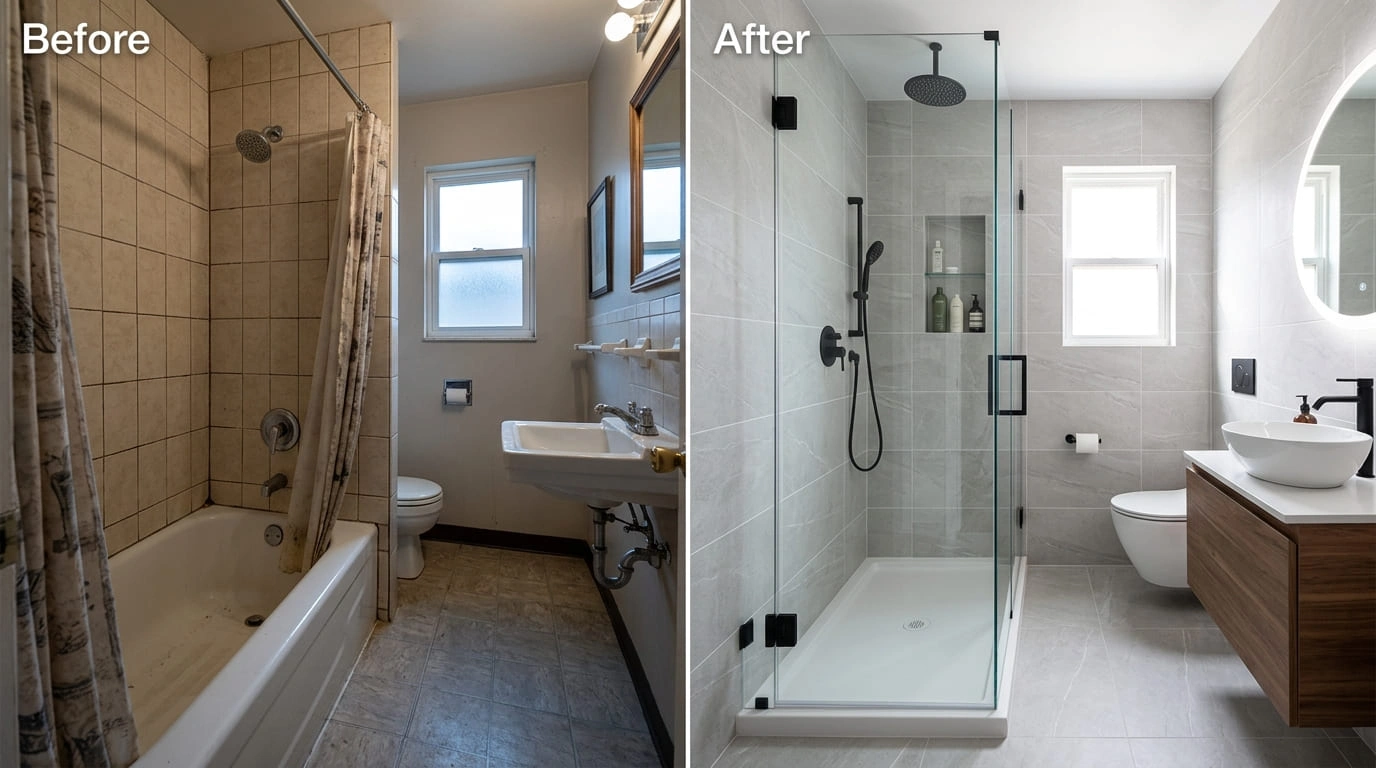
A Better Layout Starts with a Clear Goal
The most meaningful transformation is not simply a newer finish. It is a bathing area that better matches how you want to use the room.
- Before: A high tub wall complicates entry. After: A lower-entry option, where suitable, changes access.
- Before: The tub is rarely used. After: The bathing footprint serves as a dedicated shower.
- Before: Fixtures and storage feel awkward. After: Controls and accessories are planned around use.
- Before: The installation scope is uncertain. After: The completed work has an identified layout, materials, and care plan.
The result depends on the selected design and existing conditions; one project’s outcome should not be assumed for every bathroom.
How We Plan Shower Materials, Waterproofing, and Connections
Choose the Surface and the System Behind It
Acrylic, solid-surface panels, and tile offer different appearance and maintenance options. Whichever finish you choose, the underlying assembly must manage water properly.
Grout joints are not waterproof. For a tiled shower, the installation method and substrate must protect adjoining areas from water. Learn about tile installation resources from the Tile Council of North America.
- Select a shower base appropriate to the dimensions and layout.
- Follow the selected system’s installation requirements.
- Address seams, corners, penetrations, and transitions.
- Plan support for accessories before walls are closed.
- Consider cleaning requirements alongside appearance.
- Coordinate fixtures and enclosure dimensions before installation.
Should You Keep the Tub, Modify It, or Install a New Shower?
Full Conversion Is Not Always the Only Option
If your bathtub remains sound and your main concern is the surround, a more limited update may meet your goals. If entry height or bathing layout is the problem, retaining the same tub may not solve it.
| Situation | Limited repair or update | Full shower conversion |
|---|---|---|
| Sound tub with dated surroundings | Consider replacing the surround | Appropriate if you also want to remove the tub |
| Fixture problem without layout concerns | Investigate the valve or plumbing issue | Not automatically necessary |
| Difficulty stepping over the tub wall | Consider suitable modification alternatives | Allows a different base and entry |
| Unused tub and desire for a dedicated shower | Cosmetic repairs will not change its purpose | Directly addresses the goal |
| Hidden damage affecting the enclosure | Scope depends on damage | May require broader reconstruction |
A tub-cut modification retains the existing bathtub; it is not equivalent to removing it and installing a new shower system.
Full replacement is worth considering when the tub no longer suits your needs, the enclosure requires extensive rebuilding, or the selected layout cannot be achieved through a limited update.
How Much Does Tub-to-Shower Conversion Cost in Milwaukee?
Your Price Depends on the Work Behind the Finished Shower
There is no single meaningful price for every conversion. Keeping the plumbing location and choosing a standard system creates a different project from changing drainage, repairing hidden damage, installing custom tile, or adding specialized features.
A Milwaukee homeowner publicly described an approximately $16,000 estimate for removing a tub and rebuilding from the studs. That is an individual project example—not a citywide average or a Calat Milwau Plumbing quote. See the public discussion context.
Main cost drivers include:
- Wall and base materials.
- Plumbing relocation or replacement.
- Glass and enclosure design.
- Accessibility features and reinforcement.
- Access for demolition and installation.
- Hidden moisture damage.
- Permit requirements and related trades.
| Project type | How pricing is determined |
|---|---|
| Existing-footprint conversion | Selected system, plumbing compatibility, and removal scope |
| Conversion with plumbing changes | Drain, valve, supply, and access requirements |
| Custom tile shower | Preparation, waterproofing, tile work, and enclosure |
| Low-threshold or curbless design | Floor feasibility, drainage, and selected components |
| Multi-unit project | Unit condition, specifications, phasing, and access |
Ask what is included, excluded, and allowed for unforeseen conditions. Do not assume that a discount, rebate, or tax incentive applies to an ordinary bathroom remodel.
Is Removing Your Bathtub the Right Choice?
Consider Daily Use, Household Needs, and Future Plans
Tub-to-shower conversion is usually a renovation choice, not a blanket requirement. Before removing the tub, consider how your household uses it and whether another bathtub remains.
- Do children or other household members regularly use the tub?
- Is this your only bathing space?
- Is easier entry your primary goal?
- Would a surround or fixture update solve the problem?
- Are you planning to stay in the home or sell soon?
- Can the budget accommodate the desired layout and possible repairs?
Removing a bathtub does not guarantee a resale gain or loss. For a sale-focused renovation, consider advice based on your specific property and market.
Commercial Plumbing and Shower Conversion for Multi-Unit Properties
Plan Work Across Occupied Buildings and Property Portfolios
Hotels, rental apartments, and residential facilities may need conversions that balance usability, specifications, and disruption. Calat Milwau Plumbing can discuss bathing-facility improvements alongside broader commercial plumbing requirements.
| Service area | Project considerations |
|---|---|
| Bathroom assessment | Existing condition, layout, and plumbing access |
| Tub removal and shower installation | Agreed materials and unit specifications |
| Related plumbing repairs | Valves, supplies, drainage, and identified defects |
| Multi-unit planning | Phased access, water interruptions, and scheduling |
Relevant properties include rental buildings, hospitality accommodation, and facilities with bathing rooms—not every commercial building.
Where accessibility standards apply, shower dimensions, seats, controls, clearances, and grab bars require coordinated design. A “walk-in” product label alone does not establish compliance. Review U.S. Access Board bathing-room guidance.
| Project setting | Typical consideration |
|---|---|
| Occupied apartments | Resident notices and access arrangements |
| Hospitality properties | Room downtime and phased installation |
| Multiple similar units | Consistent specifications with individual assessments |
Why Choose Professional Shower Conversion Installation?
Reduce Uncertainty About Plumbing, Scope, and Coordination
Professional project planning connects the visible shower with the work behind it. That includes understanding existing conditions, selecting a compatible system, and defining responsibilities before demolition.
- Identify plumbing changes before choosing the final layout.
- Address permit responsibilities in the agreement.
- Coordinate the base, walls, fixtures, and enclosure.
- Investigate existing symptoms instead of covering them.
- Plan for household disruption.
- Retain useful product and project documentation.
What Can Go Wrong with an Improper Shower Conversion?
Water Management, Structural Changes, and Demolition Need Care
Poor connections, unsuitable assemblies, or damaged surrounding materials can create problems that are not obvious from the finished surface. Support features also need appropriate installation rather than attachment to finishes alone.
- Hidden leaks can affect adjoining walls or ceilings.
- Drain connections need assessment for the proposed installation.
- Floor modifications should not be improvised.
- Demolition may expose damaged or unsuitable materials.
- Older painted surfaces may require lead-safe practices.
EPA’s renovation rules apply to covered work disturbing painted surfaces in pre-1978 housing and certain child-occupied facilities. The rule requires certification and lead-safe practices for paid work within its scope. Review the EPA Renovation, Repair and Painting Program.
Milwaukee allows qualifying homeowners to obtain permits for plumbing in an owner-occupied single-family home; two-family and other nonqualifying properties require licensed plumbers for the permit and work. Requirements may vary by project. Review City of Milwaukee permit information.
Common Questions About Converting a Tub to a Shower
Costs, Permits, Plumbing, and Bathroom Downtime
What does a conversion cost?
The total depends on materials, plumbing, demolition, glass, access, and repair needs. Request a written scope rather than comparing prices without knowing what each includes.
Do I need a permit in Milwaukee?
Milwaukee’s published exemption covers fixture replacement without alteration to water supply, distribution, sanitary drainage, or vent systems for the stated property types. Other plumbing work requires a permit; condominium projects are not covered by that listed exemption. Confirm current requirements with the City of Milwaukee permitting department.
Can you reuse the existing bathtub drain?
Possibly, but reuse depends on its condition, location, and suitability for the proposed shower. Do not assume that every tub drain can remain unchanged.
Can the conversion be done in one day?
Some straightforward systems may support a short installation schedule, but plumbing changes, hidden damage, inspections, custom work, and product requirements can extend the project.
How long will I be without my shower?
The schedule should account for demolition, installation, inspections where required, and any manufacturer-specified waiting period before use.
Can you convert an upstairs tub in an older home?
The assessment needs to consider access, floor conditions, plumbing routes, and whether work from below is necessary.
Is acrylic or tile better?
The answer depends on appearance, budget, maintenance preferences, and installation scope. Ask about the complete system, not just the surface.
Will a new shower fix low water pressure?
Not necessarily. The cause may involve the existing fixture, valve, supply plumbing, or another issue that needs diagnosis. Learn more about shower valve repair.
What happens if you find rotten flooring or hidden damage?
The condition should be documented, explained, and addressed through the agreed scope-change process before additional work proceeds.
Can I keep my bathtub and replace only the surround?
That may be an option when the tub is sound and compatible with the proposed work. It deserves consideration if you still use the tub.
Will water splash out of a walk-in shower?
Splash control depends on the opening, enclosure, showerhead position, and layout. Discuss those details during design.
When can I use the new shower?
Follow the installation system’s requirements and the project handover instructions rather than assuming immediate use.
Move Forward with a Defined Shower Conversion Plan
Know the Work, Responsibilities, and Next Steps
Our goal is a straightforward project discussion: what you want to change, what the bathroom allows, what work is included, and how concerns will be handled.
Applicable product warranties and workmanship terms should be stated in the project documents. Those terms—not a broad advertising promise—define available remedies.
836-838 N Old World 3rd St
Milwaukee, WI 53203, United States
Plumbing Qualifications for Your Milwaukee Bathroom Project
Match Professional Responsibilities to the Installation Scope
A bathroom conversion may involve plumbing, electrical, ventilation, and finish work. Ask who is responsible for each part and which credentials apply.
Relevant plumbing credential categories include:
- Master plumber.
- Journeyman plumber.
- Restricted plumbing credentials where applicable to the task.
- Registered plumbing apprentice working within the appropriate role.
Apprentices and restricted credentials are not interchangeable with unrestricted qualifications. Milwaukee’s permit guidance also distinguishes qualifying homeowner work from projects requiring a licensed plumber. Check the City’s current permit guidance.
24/7 Emergency Plumbing for Leaks Around Your Tub or Shower
Address Active Water Problems Before Planning a Conversion
A leaking supply connection or water escaping into another room may need urgent attention. Replacing an unused tub, however, is a scheduled improvement—not an emergency installation.
- Call to describe the source and extent of the water problem.
- Explain whether water is still flowing.
- Identify affected rooms, units, or electrical areas.
- Discuss immediate plumbing assessment and repair needs.
- Plan the renovation separately after the urgent condition is addressed.
Possible urgent scenarios include active leaks, broken fixtures with uncontrolled water, and water appearing below the bathroom.
Documentation for Tub and Shower Water-Damage Claims
Separate Repairing Damage from Elective Improvements
If a plumbing incident damages your property, ask your insurer what documentation it needs before undertaking nonurgent restoration work. A preference-driven conversion should not be assumed to qualify for insurance payment.
Relevant project records may include:
- Photos of visible damage.
- Plumbing inspection findings.
- Itemized repair and replacement invoices.
- A separation between damage-related repairs and elective upgrades.
- Descriptions of completed corrective work.
Coverage depends on the policy and claim circumstances. Your insurer determines coverage; renovation work is not automatically reimbursable. For an active leak, see our water leak detection service.
Product and Workmanship Warranty Information
Know What Is Covered and How to Report a Concern
Different parts of a shower may carry different terms. The wall system, base, valve, glass, and installation labor should not be assumed to share one warranty.
| Coverage area | What to review |
|---|---|
| Workmanship | Covered labor, duration, exclusions, and remedies |
| Shower base and walls | Manufacturer terms and installation conditions |
| Fixtures and hardware | Product-specific coverage |
| Claim procedure | Contact details and required documentation |
| Maintenance requirements | Cleaning and care conditions that affect coverage |
Keep invoices, model information, and written terms. Report a concern promptly and describe where it occurs; do not assume that every future leak is covered by the same warranty.
Five Equipped Service Vans Serving Milwaukee and Nearby Areas
Project Readiness Depends on More Than Vehicle Count
Calat Milwau Plumbing’s five service vans support its wider plumbing operations. A conversion also requires planned materials, appropriate tools, product availability, and access arrangements.
- Assess delivery and removal access.
- Coordinate project-specific materials.
- Plan protection for the work route and surrounding areas.
- Identify specialty tools or additional trades needed.
- Arrange removal and cleanup within the agreed scope.
Fleet size alone does not establish installation speed or guarantee completion in a single visit.
Payment and Financing Questions for Your Shower Project
Understand the Full Commitment Before Signing
For a larger bathroom project, discuss payment arrangements early. If financing is available for your project, review the lender’s terms alongside the installation agreement.
- Ask about deposits and progress payments.
- Understand when the final balance is due.
- Review interest, fees, and repayment terms for any financing offer.
- Keep optional upgrades separate from essential work.
- Allow for documented unforeseen-condition costs.
Financing availability, approval, and terms depend on the specific arrangement. A manageable monthly payment should not obscure the total cost.
Service Excellence Starts with the Work Behind the Name
Look Beyond an Award Title When Choosing an Installer
Recognition can be one part of contractor selection, but it should not replace a relevant project discussion. Your bathroom needs an appropriate installation plan, a clear agreement, and a provider who can explain the work.
When considering industry or community recognition, look for:
- Relevance to the service you are purchasing.
- A clear connection to the business.
- Consistency with the provider’s actual capabilities.
- Practical evidence of planning and workmanship.
For your conversion, the written scope and installation approach remain central to the decision. Any award or recognition should be confirmed with its issuer before being represented as current.
Discount Questions for Seniors, Veterans, and New Customers
Understand Eligibility and Savings Before Booking
Customers seeking a senior or military discount should ask whether an applicable offer is available. Calat Milwau Plumbing’s listed promotions include a first-time customer discount and tiered repair service credits; applicability to a conversion project should be discussed.
- Ask which services qualify.
- Request the discount amount and conditions.
- Understand whether offers can be combined.
- Check whether optional products are excluded.
- Have any agreed savings reflected in the project price.
Do not assume an advertised plumbing special applies to a complete bathroom renovation. Review current offers and project eligibility directly with the business.
Calat Milwau Plumbing Hours in Milwaukee, WI
24/7 Emergency Availability, with Conversion Work Scheduled Separately
Our listed operating hours provide around-the-clock contact availability for plumbing needs. Bathroom assessments, materials coordination, and conversion installation are scheduled according to the project.
| Day | Listed operating hours |
|---|---|
| Monday | 24 hours |
| Tuesday | 24 hours |
| Wednesday | 24 hours |
| Thursday | 24 hours |
| Friday | 24 hours |
| Saturday | 24 hours |
| Sunday | 24 hours |
Phone: Call (414) 279-2050
Email: calatmilwauplumbing@gmail.com
Website: Calat Milwau Plumbing
How Should You Compare Milwaukee Shower Conversion Providers?
Use the Same Questions for Every Estimate
A lower total may exclude work another proposal includes. Ask each provider to explain the same scope before deciding which offers better value.
| Comparison point | Ask Calat Milwau Plumbing | Ask other providers |
|---|---|---|
| Existing conditions | What can stay, and what needs replacement? | Is the recommendation based on an assessment? |
| Plumbing | Which alterations are included? | Are drain and valve changes priced separately? |
| Waterproofing | What installation system is proposed? | How are seams and transitions handled? |
| Permits | Who handles required permits? | Is responsibility stated in writing? |
| Timeline | What is the expected bathroom downtime? | What could extend the schedule? |
| Hidden damage | How are additional repairs authorized? | Is there a written change process? |
| Warranty | What terms apply to labor and products? | Are exclusions and remedies clear? |
The best comparison is between complete, understandable proposals—not unsupported claims about a “typical competitor.”
Contact Calat Milwau Plumbing for Your Shower Conversion
Discuss the Layout, Cost, and Plumbing Before You Commit
Tell us what you want to change: easier entry, a dedicated standing shower, updated finishes, or a more practical bathing area. We can discuss the existing bathroom, your priorities, and the next steps toward an assessment.
Have your project address, approximate timeframe, and bathroom photos ready if available. Mention upstairs access, condominium rules, or whether this is your only shower.
Project Contact Information
Phone: (414) 279-2050
Email: calatmilwauplumbing@gmail.com
Service page: Tub-to-Shower Conversion
Address: 836-838 N Old World 3rd St, Milwaukee, WI 53203
Plan Your Assessment
Create a bathroom that better fits your daily needs with tub-to-shower conversion in Milwaukee, WI, from Calat Milwau Plumbing.
Share your goals, bathroom layout, and any known plumbing concerns so the next steps can be discussed clearly.