Sewer Lateral Repair & Replacement in Milwaukee, WI — Available 24/7
Milwaukee County sewer specialists focused on your property, repair options, and service continuity
When you need sewer line repair in Milwaukee, you need more than another temporary drain clearing. You need to understand what is blocking the pipe, where the damage is, and whether cleaning, a localized repair, relining, or replacement makes sense.
Calat Milwau Plumbing helps homeowners, landlords, and commercial property managers address recurring backups, root intrusion, and damaged sewer laterals. Our business brings experience dating to 1990, a team of 50 skilled professionals, five equipped service vans, and 24/7 emergency availability to your plumbing concerns.
From a basement floor-drain backup to a planned commercial sewer replacement, start with a clear assessment—not an automatic recommendation to replace everything.
- Residential and commercial sewer repair planning.
- Camera inspection and defect-location services.
- Repair and replacement options explained before authorization.
- Emergency plumbing assistance available around the clock.
Call +1 (414) 279-2050 to discuss symptoms, scheduling, and the next step.
Request Sewer Service
Tell us about the backup, inspection findings, or repair question.
Active backup? Call (414) 279-2050.
Sewer Line Repair & Replacement Backed by Experience Since 1990
A practical approach to protecting your home or keeping your business operating
An underground pipe problem should not leave you guessing about a major purchase. Calat Milwau Plumbing focuses on explaining the findings, identifying the affected section, and separating necessary work from optional upgrades.
Your estimate should explain whether the proposed work covers a spot repair, the exterior lateral, the connection to the public main, or piping beneath the building. Access and restoration matter just as much as the pipe itself.
Established in 1990
Experience serving Milwaukee-area plumbing needs.
50 Skilled Professionals
A team supporting residential and commercial work.
Five Equipped Vans
Local service capacity for varied property needs.
Residential & Commercial
Plumbing capabilities for homes and operating properties.
Defined Project Scope
Discuss affected sections, access, permits, and restoration.
24/7 Emergency Availability
Call to discuss urgent plumbing concerns.
Milwaukee’s plumbing permit guidance identifies qualifying credentials for permit applicants and provides for inspections as work progresses. Proper project planning includes those requirements—not simply completing the excavation. City of Milwaukee plumbing permits and inspections.
Sewer Repair Near Milwaukee Neighborhoods and Business Districts
Local support from downtown commercial properties to neighborhood homes
A sewer project near the Milwaukee RiverWalk may involve different access considerations from a residential lateral in Bay View or a multi-unit building in Riverwest. Parking, basement access, occupied spaces, paved surfaces, and operating hours all affect the work plan.
Calat Milwau Plumbing serves Milwaukee neighborhoods and nearby cities, helping property owners plan around the actual site rather than a generic repair package.
Milwaukee Neighborhoods
- Bay View
- Riverwest and Walker’s Point
- Westown and East Town
- Brewers Hill and Harambee
- Lower East Side
- Historic Third Ward and Mitchell Street
- Layton Park and Lincoln Village
- Marquette / Avenues West
Nearby Communities & Hubs
- Wauwatosa, West Allis, and West Milwaukee
- Shorewood and St. Francis
- Waukesha, Racine, and Kenosha
- Fiserv Forum and Milwaukee Public Market
- Milwaukee RiverWalk and downtown corridors
For properties throughout southeastern Wisconsin, scheduling begins with the address, symptoms, access requirements, and proposed service scope. Explore our service areas.
Specialized Sewer Diagnostics for Residential and Commercial Plumbing
Understand the pipe before choosing the repair
A line that drains after snaking is not necessarily a structurally sound line. Roots can be removed while the joints or cracks that admitted them remain.
A Milwaukee-area inspection demonstration shows this distinction: cleaning restored the view through a clay sewer, but the camera then revealed a broken section near the main connection. View the local sewer inspection demonstration.
Our Sewer-Service Approach
- Review backup history and previous cleaning intervals.
- Inspect accessible piping and cleanouts.
- Use camera findings to distinguish obstruction from visible damage.
- Locate defects when equipment and access permit.
- Discuss repair options according to condition and location.
- Explain whether additional cleaning or investigation is needed.
A good recommendation answers “Why this repair?” as clearly as “How much?” Learn about sewer camera inspection.
What Happens When a Milwaukee Sewer Lateral Fails?
Why is sewage coming up through the basement floor drain?
Your sanitary sewer lateral carries wastewater from the building to the public sewer main. If that route becomes obstructed, wastewater may back up instead of leaving the property. Defects can also admit groundwater, adding unwanted water to the sanitary system. MMSD lateral and Pipe Check information.
Basement Floor-Drain Backup
Wastewater rises through a low drain.
Several Slow Fixtures
Multiple fixtures drain poorly together.
Roots Return After Cleaning
Root removal does not always repair entry points.
Wet-Weather Backups
Rain correlation is useful information, not a diagnosis.
Visible Pipe Damage
Camera findings show cracks or displaced joints.
Private or Public Concern?
Determine which system and section are involved.
Neighboring backups can be useful information, but they do not establish the cause by themselves. Report suspected public sewer issues to Milwaukee at 414-286-2489, and arrange assessment of the private lateral as appropriate. Milwaukee sewer information.
Does Your Sewer Line Need Annual Maintenance?
Set the schedule around condition, history, and property use
There is no one-size-fits-all inspection schedule for every sewer lateral. A property with recurring roots or repeated backups needs a different plan from a property with a documented, functioning line.
MMSD encourages homeowners with frequent backups or repeated lateral cleaning to investigate their piping and sources of clear-water entry. MMSD lateral program information.
| Task | Description | Typical Timing | Purpose |
|---|---|---|---|
| History review | Review backups, cleaning dates, and previous repairs | Initial assessment and follow-up | Identify recurring patterns |
| Camera inspection | Examine accessible piping for visible defects | When symptoms or history warrant | Inform repair decisions |
| Cleaning | Remove suitable obstructions using an appropriate method | According to condition | Restore flow and improve visibility |
| Post-cleaning review | Reinspect when included and accessible | After cleaning | Assess remaining defects |
| Maintenance planning | Set an appropriate follow-up interval | After findings are reviewed | Reduce reactive decision-making |
Practical Maintenance Habits
- Address recurring problems before access or scheduling becomes difficult.
- Coordinate commercial maintenance with operating hours.
- Keep inspection footage, estimates, and invoices.
- Maintain access to cleanouts.
- Do not mistake a maintenance visit for an annual certification requirement.
Costs Depend on Scope
Access, cleaning needs, inspection coverage, and findings can affect the estimate. Keep prior footage and reports available when requesting service.
Who Needs Sewer Repair in Milwaukee?
Homeowners, landlords, businesses, and facility managers
A homeowner may need reassurance about basement disruption. A restaurant may need a plan for restroom availability. A landlord may need tenant notices and access coordination. Calat Milwau Plumbing approaches each sewer project according to the building, occupants, and consequences of interrupted drainage.
Homeowners
For backups and recurring clogs.
Duplex Owners & Landlords
Coordinate shared plumbing and tenant needs.
Apartments & Multi-Unit Buildings
Plan access and service continuity.
Restaurants & Hospitality
Consider operating hours and customer access.
Retail & Mixed Use
Address drainage issues across active properties.
Facilities & Industrial Sites
Coordinate relevant sanitary drainage needs.
Residential and commercial sewer service should account for the people using the property—not only the pipe beneath it. See commercial plumbing services.
How Do Rain and Snowmelt Affect Sewer Laterals?
Groundwater can expose defects that remain hidden in dry weather
Rainwater does not belong in a separate sanitary sewer simply because it is raining. However, groundwater can enter through defective laterals, and connected foundation drains or downspouts can contribute additional clear water. MMSD identifies these sources as factors that increase backup risk. MMSD Pipe Check information.
Not every wet basement is a sewer problem. Foundation drainage, sump discharge, surface water, and the sanitary lateral require separate consideration. Related support may include sump-pump repair or water-damage restoration.
Common Sewer Pipe Conditions and Repair Considerations
Material matters, but condition drives the recommendation
A sewer camera can help identify visible pipe characteristics and defects. The decision to repair or replace should consider the inspected condition rather than the age of the house alone.
| Pipe or Condition | What the Assessment Considers | Key Concern | Planning Value |
|---|---|---|---|
| Clay-tile lateral | Joints, roots, cracks, and displaced sections | Openings and structural damage | Compare cleaning, repair, and rehabilitation |
| Cast-iron piping | Visible deterioration, deposits, and accessible sections | Restricted flow or damaged piping | Define affected scope |
| Plastic piping | Connections, deformation, visible damage, and drainage behavior | Installation or localized defects | Assess targeted work |
| Mixed-material line | Transitions and previous repairs | Connection or repaired-section concerns | Avoid overlooking part of the route |
A local inspection demonstration documents roots, shifting, cracks, and missing sections in an inspected clay sewer; it does not establish that every older Milwaukee property has the same condition. View the demonstration.
Our 6-Step Sewer Repair and Replacement Process
Know what to expect from Calat Milwau Plumbing
Initial Call & Property Assessment
Discuss address, affected fixtures, backup history, previous inspections, and urgency.
Inspection Access & Setup
Identify cleanouts, review access, and determine whether cleaning is needed before camera inspection.
Diagnostic Inspection & Locating
Examine accessible piping and identify visible problems, location, and inspection limits.
Repair or Replacement Options
Explain methods, scope, pricing factors, access, interruption, and restoration responsibilities.
Authorized Work & Documentation
Proceed with approved work, incorporating applicable permits and inspections.
Completion Review & Follow-Up
Review completed work, available records, maintenance recommendations, and written project terms.
Cleaning before inspection may be necessary when a line is completely obstructed. Visibility and access can affect the diagnostic sequence. See the local sewer demonstration.
What Is Included in Your Sewer Service?
Inspection, repair, and replacement are different scopes
An inspection visit is not the same purchase as a full lateral replacement. Your proposal should identify the actual work and its boundaries.
Depending on the Selected Service, the Scope May Include:
- Review of symptoms and previous service history.
- Access and cleanout assessment.
- Camera inspection of accessible piping.
- Cleaning needed for diagnosis, when authorized.
- Defect location and discussion of findings.
- Repair or replacement recommendations.
- Written description of approved work.
- Applicable permit and inspection coordination.
- Completion records and restoration details.
Clarify Before Signing
Ask whether the estimate includes pipe beneath the basement floor, the main connection, street/driveway/sidewalk work, standard lawn restoration, and finished-surface repairs.
Milwaukee’s municipal replacement page illustrates why standard restoration and ornate landscaping or finished-basement work are not identical categories. City lateral replacement information.
Sewer Service Built Around Clear Decisions
Diagnosis, communication, and project coordination
A major sewer project should not be sold through urgency alone. You should understand the evidence, the choices, and the work involved. Calat Milwau Plumbing combines sewer services with broader residential and commercial plumbing support.
Inspection-Led Discussion
Connect visible defects to the repair options under consideration.
Finding-Based Repair Options
Discuss options according to observed pipe conditions.
Cleaning vs Structural Repair
Understand why restoring flow and repairing structure differ.
Access & Restoration Planning
Define the work area and property impacts before authorization.
Occupied Commercial Properties
Discuss scheduling around business operations — commercial plumbing.
Emergency Availability
Call about urgent plumbing concerns and recurring backups.
The goal is straightforward: make the underground problem understandable before you commit to the solution.
What Changes After a Sewer Problem Is Diagnosed?
A useful transformation includes evidence—not only a clean-looking yard
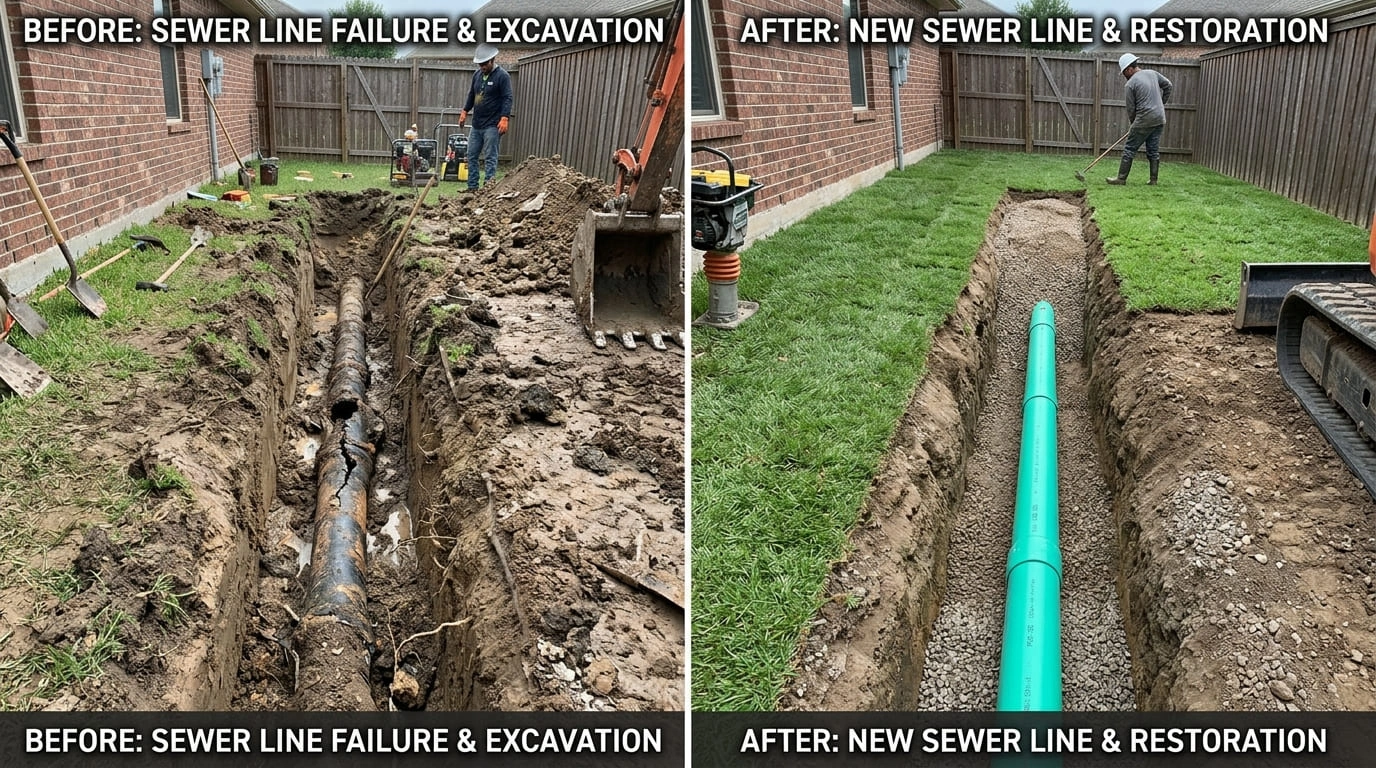
The Most Important Before-and-After May Be What You Know About the Pipe
A camera inspection can reveal a defect hidden behind roots or debris. The local inspection demonstration shows both the cleaned line and a remaining broken section, emphasizing why restored flow and repaired structure are different outcomes. See the local inspection demonstration.
- Before: Repeated cleaning without a clear explanation. After: Findings that inform maintenance or repair decisions.
- Before: Uncertainty about the affected length. After: A proposed scope identifying the section to address.
- Before: Concern about excavation and disruption. After: An access, interruption, and restoration plan.
- Before: Missing project records. After: Available documentation of authorized work.
Inspection helps define the next step. It does not itself remove roots, repair cracks, or guarantee future drainage.
How Can a Sewer Lateral Be Repaired or Replaced?
Compare localized repair, lining, pipe bursting, and excavation
“Trenchless” describes an approach, not a guarantee that no digging or indoor access will be necessary. MMSD identifies cured-in-place lining, open-cut replacement, and pipe bursting among approved project categories. Suitability depends on the property and proposed work. MMSD Pipe Check program information.
| Method | General Approach | Questions to Resolve |
|---|---|---|
| Localized repair | Address a defined damaged section | Is the remaining line suitable to retain? |
| CIPP lining | Install a cured-in-place liner within an existing lateral | Is the existing route suitable for rehabilitation? |
| Pipe bursting | Replace the lateral using a trenchless replacement method | What access and site conditions are required? |
| Open-cut replacement | Excavate to remove and replace piping | What surfaces and restoration are included? |
Method Selection Should Account For:
- Materials and connections in the approved design.
- Access, utilities, and inspection requirements.
- Method limitations before authorization.
- Surface restoration obligations in writing.
Ask how camera findings support a proposed method. Related diagnostics include sewer camera inspection.
Should You Repair, Reline, or Replace Your Sewer Lateral?
The answer should follow the findings—not a predetermined sales pitch
Tree roots do not automatically mean full replacement. However, removing roots does not repair the openings through which they entered. A camera review and site assessment help determine whether continued maintenance, a localized repair, rehabilitation, or replacement deserves consideration. View the local inspection example.
| Finding or Situation | Repair or Rehabilitation May Be Considered | Replacement May Be Considered |
|---|---|---|
| Isolated defect | When a defined section can be addressed | When broader damage makes spot repair insufficient |
| Recurring roots | When the underlying opening can be addressed appropriately | When condition or extent favors replacement |
| Widespread visible damage | Only if a suitable rehabilitation approach is established | When retaining the line is not appropriate |
| Uncertain pipe condition | Further cleaning or investigation may be needed | Not solely because visibility is incomplete |
| Repeated service expense | Compare maintenance and repair options | Compare long-term scope and project cost |
Replacement deserves serious consideration when damage is extensive, localized work would leave significant problems, or proposed rehabilitation does not adequately address the findings.
How Much Does Sewer Lateral Replacement Cost in Milwaukee?
Compare complete estimates—not headline numbers
There is no reliable one-price answer without examining the property. Pipe length, access, repair method, connection work, and restoration can materially change the proposal.
Why can a sewer quote exceed $10,000? A long or complex replacement is a different project from clearing roots or repairing one accessible section. Local homeowner discussions reflect this concern, but reported bills should not be treated as a current citywide average. Read a local homeowner discussion.
Main Cost Drivers
- Length and location of affected piping
- Access to basement and exterior work area
- Cleaning and diagnostic requirements
- Localized repair versus rehabilitation or replacement
- Street, driveway, sidewalk, or basement-floor work
- Permits, inspections, and project coordination
- Restoration inclusions and exclusions
Request a Defined Estimate
Ask whether the estimate covers a section or the entire lateral, including its main connection. Confirm access, permits, restoration, and exclusions.
Request a Sewer Repair EstimateCall (414) 279-2050 to discuss the property.
| Service Type | Pricing Approach |
|---|---|
| Camera inspection | Access, scope, and any required cleaning |
| Localized repair | Location, affected section, and restoration |
| Lateral lining | Suitability, preparation, and proposed length |
| Full replacement | Method, site conditions, connections, and complete scope |
| Commercial project | Access, operational requirements, and project extent |
Public incentives are separate from a contractor’s project price. Ask what assistance programs may apply to your property.
Which Properties Need Sewer Repair or Replacement?
Recurring symptoms, documented defects, and code notices deserve attention
Not every property needs a new sewer lateral. A repair decision should reflect symptoms, inspected condition, and any applicable notice—not simply the building’s age.
Repeated Root Intrusion
Roots return after repeated cleaning.
Ongoing Backups
Symptoms continue without a clear diagnosis.
Documented Pipe Damage
Inspection shows broken or displaced piping.
Unclear Repair Scope
Understand the work before approving it.
Defective-Lateral Notice
Review applicable requirements and timing.
Failed Dye Test
Identify the defect and required next steps.
Milwaukee states that owners own the lateral through its connection to the main. Its targeted replacement program assists qualifying owner-occupied properties with defective-lateral violations in the separated sewer system; it is not universal free sewer replacement. City lateral program details.
Commercial Plumbing and Sewer Repair in Milwaukee
Sewer solutions for businesses, multi-unit properties, and facilities
Commercial sewer problems can affect tenants, staff, customers, and operating schedules. Calat Milwau Plumbing helps owners and managers discuss the repair alongside access requirements and service continuity.
Commercial plumbing services in Milwaukee should distinguish an urgent blockage from a planned capital project. The communication and scheduling needs differ.
| Commercial Service | Project Focus |
|---|---|
| Sewer assessment | Review symptoms, access, and available inspection history |
| Diagnostic inspection | Identify visible problems in accessible piping |
| Repair planning | Define affected sections and suitable options |
| Replacement planning | Coordinate scope, interruption, and restoration |
| Maintenance planning | Address recurring issues and records |
Commercial Properties
- Restaurants, cafés, and hospitality
- Retail centers and mixed-use buildings
- Apartments and managed portfolios
- Schools, churches, and community facilities
- Warehouses and industrial properties
Commercial Planning Benefits
- Schedule around operations
- Define access and project boundaries
- Separate diagnosis from approved work
- Account for occupants and service continuity
| Property Situation | Planning Consideration |
|---|---|
| Occupied multi-unit building | Access and tenant communication |
| Business with customers onsite | Service interruption and operating schedule |
| Multiple buildings | Phased investigation and defined priorities |
| Restricted-access facility | Entry procedures and work-area coordination |
Why Choose Professional Sewer Service?
Protect your budget by understanding the problem
Professional assessment helps turn an alarming symptom into a defined next step. The value is not automatically a bigger repair—it is a clearer decision.
Clarify the Immediate Need
Distinguish cleaning, investigation, and structural work.
Understand the Evidence
Review what the camera shows and what remains uncertain.
Compare Repair Options
Consider methods in relation to pipe condition.
Plan Access & Restoration
Define property impacts before excavation.
Keep Useful Records
Retain information for service and property management.
Plan Project Requirements
Incorporate permits and inspections where applicable.
Milwaukee’s plumbing guidance makes permits and progressive inspection part of the work process. City plumbing permit information.
What Should You Do During a Basement Sewer Backup?
Avoid exposure and electrical hazards while arranging help
Do not treat sewage-contaminated water as ordinary clean water. Keep children and pets away, avoid contact, and do not enter standing water to reach electrical equipment.
CDC guidance warns against operating electrical equipment while standing in water. If accessing the main switch requires entering water, call an electrician rather than attempting the shutoff yourself. CDC flood safety guidance.
Sewer Line Repair & Replacement FAQs
Clear answers before you approve the work
Why does my sewer keep backing up after it was snaked?
Cleaning may remove an obstruction while leaving the defect that allowed it to develop. Roots, damaged joints, or other visible problems may require inspection and a separate repair discussion. See a local inspection example.
Can a clay-tile lateral be relined instead of replaced?
Sometimes lining is an option, but suitability requires assessment. It should not be promised solely because the pipe is clay or because excavation is undesirable. MMSD program information.
Who owns the sewer lateral under the street in Milwaukee?
The City states that property owners own the pipe from the home through the connection to the sewer main. Location under a public surface does not by itself mean the private lateral is City-owned. City lateral program information.
Can I use the toilet during sewer replacement?
Plan for a period when affected plumbing cannot be used. Duration and temporary reconnection depend on the project; confirm the interruption plan with the contractor.
Will replacement stop every possible basement backup?
No universal promise is appropriate. Public-system conditions and other private-property water sources can remain relevant even after a lateral defect is addressed.
Does Milwaukee offer financial assistance for sewer repairs?
MMSD Pipe Check offers incentives for eligible homes and approved work. Milwaukee also operates a separate targeted program for qualifying defective-lateral violations. Eligibility and contractor requirements differ. MMSD Pipe Check | City lateral program.
What does a failed dye test mean?
For the City’s described program, dye flushed through the toilet was observed in the storm sewer, indicating a defect requiring correction. The notice and City guidance determine next steps. Review the City program.
Are emergency sewer services available?
Calat Milwau Plumbing offers 24/7 emergency availability. Call to discuss the situation, dispatch scheduling, and whether immediate mitigation or planned repair is appropriate.
A Sewer Service Commitment Built Around Communication
Understand the recommendation, scope, and next step
Calat Milwau Plumbing’s focus is straightforward: help you understand the sewer problem and the proposed work before moving forward.
Ask questions about inspection findings, alternatives, exclusions, restoration, and written project terms. A guarantee should mean something specific—not simply promise that your property will never experience another backup.
If a concern develops after completed work, contact the team with your project information so the issue can be reviewed against applicable written terms.
Licensed Sewer Work and Milwaukee Permit Requirements
Match responsibility to the required qualification
Sewer projects can involve permit applications, inspections, and work requiring appropriate professional credentials. Milwaukee lists Master Plumber, certain restricted Master Plumber credentials, and a qualifying Utility Contractor among credential categories for plumbing permit applicants. The appropriate category depends on the work involved. Milwaukee plumbing permit requirements.
Master Plumber
Credential category for applicable plumbing responsibilities.
Journeyman Plumber
Credential relevant to assigned plumbing work.
Restricted Plumbing Credentials
Apply within their authorized scope.
Registered Apprentice
Works under applicable supervision.
Utility Contractor
May be relevant to specified permit applications.
Ask who will perform the work, how the project is organized, and what permit responsibilities are associated with the proposal. Learn about Calat Milwau Plumbing.
24/7 Emergency Sewer Service in Milwaukee
Start with the symptoms and the immediate risk
A rising basement backup, unusable fixtures, or suspected major obstruction needs prompt assessment. Call Calat Milwau Plumbing at +1 (414) 279-2050 to describe what is happening.
Emergency assistance begins with determining urgency and the appropriate next step. It does not automatically mean a complete lateral replacement can begin immediately.
- Phone discussion of affected fixtures and backup conditions.
- Scheduling based on urgency and availability.
- On-site assessment and appropriate diagnostic planning.
- Discussion of mitigation, cleaning, or further repair needs.
- Documentation of authorized work.
Suspected public sewer problems can also be reported to Milwaukee at 414-286-2489. City sewer information.
Emergency Plumbing Contact
Call to discuss a rising backup, repeated blockage, or drainage interruption.
Call (414) 279-205024/7 emergency availability
Basement Backup
Wastewater rising through a floor drain.
Recurring Blockage
Symptoms return after recent clearing.
Business Disruption
Drainage failure affects normal operations.
Sewer-Related Insurance Documentation Support
Keep the cause, damage, and repair scope clearly separated
Insurance questions often arise after a backup or when a costly lateral defect is discovered. Coverage depends on the policy and circumstances; a contractor’s invoice does not establish eligibility.
Local homeowner discussions include different experiences with coverage, reinforcing why another person’s claim outcome is not a reliable prediction for your property. Read a local homeowner discussion.
Inspection Findings
Accessible pipe observations and diagnostic notes.
Photographs
Visible damage, where available.
Camera Footage
Recording included in the agreed inspection scope.
Defect Location
Location details where determined and documented.
Invoices & Work Scope
Authorized repair or replacement details.
Discuss the damaged pipe and resulting property damage separately with your insurer. Calat Milwau Plumbing documents its work; it does not decide coverage or guarantee reimbursement.
Sewer Repair and Replacement Warranty Considerations
Written terms should define what is covered
Warranty expectations belong in the proposal, not only in a conversation after work is complete. Ask for the terms applicable to the selected materials, installation, and workmanship.
| Coverage Area | What to Establish |
|---|---|
| Workmanship | Covered work, duration, and remedy |
| Installed materials | Applicable manufacturer terms |
| Existing piping | Whether retained sections are outside the new-work scope |
| Restoration | What surfaces and finishes are included |
| Claim procedure | Who to contact and what records to provide |
| Exclusions | Conditions or unrelated problems not covered |
A warranty on repaired piping should not be mistaken for protection against every municipal backup, foundation-water problem, or issue elsewhere in the plumbing system.
Five Equipped Service Vans Supporting Milwaukee Plumbing Calls
Diagnostic work and major construction require different resources
Calat Milwau Plumbing’s five equipped service vans support residential and commercial plumbing service across its coverage area. A sewer inspection, drain cleaning, and full lateral replacement do not require identical equipment. Project planning identifies the tools, parts, access, and construction resources appropriate to the authorized work.
- Sewer inspection cameras and locating equipment.
- Cleaning tools suited to the pipe and obstruction.
- Plumbing tools and commonly needed service materials.
- Additional excavation or trenchless resources when required.
- Work-area protection and project-specific access arrangements.
The local inspection demonstration emphasizes matching cleaning equipment to pipe size and using the camera to assess results. View the demonstration.
Milwaukee Service Resources
Supporting homes and businesses throughout Milwaukee and nearby communities.
Discuss Your Sewer ProjectFinancial Assistance for Milwaukee Sewer Projects
Public incentives and financing are different tools
A major project may require more planning than an emergency service visit. Ask about payment arrangements associated with your proposal and investigate public programs separately.
Discuss Payment Terms
Ask about any arrangements available for your proposal.
Review Program Eligibility
Public assistance has separate requirements.
Define the Balance
Understand what remains your responsibility.
MMSD Pipe Check lists 6,000–8,000 incentives for qualifying full lateral replacement and $1,500 for qualifying lining. Incentives do not cover the full project cost, rates can change, and an MMSD-approved contractor is required. Eligibility applies. MMSD Pipe Check program.
Milwaukee’s separate targeted lateral program has different eligibility and contractor arrangements. Do not assume a privately selected contractor or every damaged lateral qualifies. City lateral program details.
What Should Recognition Mean to a Sewer Customer?
Focus on the standards that matter on your property
Awards can provide background, but they do not replace a sound diagnosis or a well-defined estimate.
Understandable Findings
Ask for a clear explanation of inspection results.
Suitable Options
Review reasonable alternatives for the findings.
Clear Scope & Price
Understand boundaries, charges, and exclusions.
Permit Planning
Ask how permits and inspections are handled.
Property Respect
Discuss occupied spaces and access in advance.
Before You Approve:
- Review restoration details.
- Ask about written warranty terms.
- Confirm the authorized project limits.
- Keep a copy of the proposal and records.
The goal is a clear and responsive process—from first call through completion.
Sewer Service Discounts and Current Offers
Discuss eligibility before authorizing work
If you are a senior, active-duty service member, or veteran, ask whether an applicable offer is available for your proposed service. Do not assume a discount applies to every diagnostic visit, excavation, or replacement project.
An advertised drain-clearing special is not automatically the price of structural sewer repair.
Ask About Current Offers
Request eligibility and terms for your specific proposal.
Call (414) 279-2050Sewer Service Hours in Milwaukee, WI
24/7 emergency availability with planned project scheduling
Calat Milwau Plumbing offers emergency availability seven days a week. Planned inspections and major repair work are scheduled according to the property, scope, access requirements, and project needs.
| Day | Emergency Availability |
|---|---|
| Monday | 24 Hours |
| Tuesday | 24 Hours |
| Wednesday | 24 Hours |
| Thursday | 24 Hours |
| Friday | 24 Hours |
| Saturday | 24 Hours |
| Sunday | 24 Hours |
For an active backup, call rather than relying on email.
How Should You Compare Milwaukee Sewer Contractors?
Use the same questions for every estimate
The most useful comparison is whether each proposal addresses the same pipe, defect, method, and restoration scope.
| Feature | What to Discuss With Calat Milwau Plumbing | What to Ask Any Provider |
|---|---|---|
| Diagnosis | Findings supporting the recommendation | Can you explain or show the defect? |
| Scope | Proposed repair limits and connection work | Is this a section or the complete lateral? |
| Alternatives | Suitable options for the findings | Why is another method unsuitable? |
| Availability | Emergency and project scheduling | What can happen now and what is scheduled later? |
| Permits | Responsibilities for proposed work | Who obtains permits and coordinates inspections? |
| Restoration | Included surfaces and exclusions | Who repairs the floor, lawn, and pavement? |
| Warranty | Applicable written terms | What is covered and what is excluded? |
| Final price | Approved scope and change procedures | What could change the quoted amount? |
A lower quote is not necessarily equivalent if it excludes work included in another proposal.
Contact Calat Milwau Plumbing for Sewer Service in Milwaukee
Talk through symptoms, inspection findings, or a replacement proposal
Whether sewage is rising through your basement floor drain, roots keep returning, or you are comparing relining with replacement, start with a conversation about the actual problem.
Tell us the property address, affected fixtures, when the backup occurs, and whether you have previous inspection footage. For commercial properties, include operating hours, access restrictions, and tenant or customer impacts.
Sewer Service Contact
+1 (414) 279-2050
Sewer Line Repair & Replacement
836–838 N Old World 3rd St, Milwaukee, WI 53203, USA
Helpful Details for Your Call
- Property address and affected fixtures
- Backup timing and previous service
- Inspection footage or repair notice
- Operating hours and access restrictions
Get an informed diagnosis, clearly explained options, and a defined project scope for sewer line repair in Milwaukee.
Request Sewer Service
Describe your symptoms, inspection findings, and access needs.
Sewer Repair and Replacement Service Areas
Service planning begins with your property address, symptoms, access, and project scope. View service areas.